Clutter rarely takes over a home all at once. It usually grows slowly: a few unopened boxes after a move, clothes that no longer fit, duplicate kitchen tools, unfinished hobby supplies, sentimental objects, paperwork, and things kept because they might be useful someday.
Eventually, there may be so many possessions that deciding where to begin feels harder than simply leaving everything where it is.
That is why successful decluttering is not only about finding enough trash bags or buying better storage containers. For people who have a strong attachment to possessions, the harder work is often making decisions without becoming exhausted, anxious, or stuck.
You Might Also Like:
- Loading posts...
The goal does not have to be an extremely minimalist home. A much more practical goal is to create a space where belongings are usable, important items are accessible, rooms can function as intended, and cleaning does not require constantly moving piles from one place to another.
Here are seven realistic ways to begin.
Why Letting Go Can Feel So Difficult
Before clearing anything, it helps to understand why possessions accumulate.
Different people keep things for different reasons, and several of these reasons can exist at the same time.
Fear of Needing Something Later
One of the most common thoughts behind clutter is:
“I might need this someday.”
Occasionally, that is sensible. Keeping a spare flashlight or an extra set of bedsheets is different from keeping large quantities of objects that have little realistic chance of being used.
The difficulty is that almost anything can theoretically become useful in the future.
An empty container could hold something. An old appliance might provide a spare part. A shirt that no longer fits might fit again. A stack of magazines might contain an article worth reading.
If “possibly useful someday” becomes the main standard for keeping possessions, almost nothing qualifies for removal.
A more useful question is whether the item deserves the space and attention it requires today.
Attachment to a Future Version of Yourself
Some possessions represent plans rather than current needs.
You may have exercise equipment for a routine you no longer follow, craft supplies for projects you never started, clothing for a different lifestyle, or books related to an interest you abandoned years ago.
Keeping a few aspirational possessions is normal. Trouble begins when your current home becomes storage for dozens of possible future lives.
Decluttering does not mean giving up every ambition. It means deciding which goals are important enough to receive space in your present life.
Sentimental Attachment
Objects can become connected to people, experiences, achievements, and periods of life.
A chipped mug might remind you of a relative. Children’s clothes may represent years that passed quickly. Old notebooks can feel like evidence of who you once were.
Because of that emotional connection, deciding whether to keep an object can feel much more significant than deciding what to do with an ordinary household item.
There is no rule saying sentimental possessions must be discarded. The objective is to keep the items that carry the most meaning rather than allowing hundreds of less-important objects to bury the truly special ones.
Too Many Past Interests and Collections
Possessions also accumulate as life changes.
You may once have collected DVDs, then books, then craft materials, then kitchen equipment. Each interest may have faded while the physical collection remained.
After enough years, one home can contain belongings from several different versions of the same person.
Reviewing those collections gives you an opportunity to decide which interests still belong in your life.
Decision Fatigue Is a Major Part of Decluttering
Sorting possessions can be surprisingly tiring because almost every item requires a decision.
Keep it.
Donate it.
Sell it.
Recycle it.
Throw it away.
Move it somewhere else.
Repair it.
Ask someone whether they want it.
Repeat that process hundreds of times and even simple choices can begin to feel difficult.
This is one reason ambitious whole-house decluttering days often fail. A person begins with energy, creates several piles, becomes mentally exhausted, and stops before anything has actually left the house.
A better system reduces the number and difficulty of decisions you need to make at one time.
1. Slow Down What Comes Into the House
Decluttering becomes much harder if possessions continue arriving faster than they leave.
You do not need to stop shopping completely. Start by adding a little friction before bringing nonessential items home.
Before purchasing something, ask:
- Where will I keep it?
- Do I already own something that does the same job?
- Am I buying it for my current life or an imagined future one?
- Would I still want it if it were not discounted?
- Is the item worth the storage space it will permanently require?
Pay particular attention to categories that already create clutter in your home.
If your closet is overflowing, temporarily stop buying clothes. If craft supplies are filling several rooms, use what you have before adding another project. If bargain shopping creates duplicates, avoid buying something simply because the price seems too good to pass up.
Stopping or reducing the inflow gives your decluttering work a chance to make a visible difference.
2. Start With an Area Small Enough to Finish
“I need to declutter my house” is not a useful task.
It is too large, too vague, and almost impossible to complete in one session.
Choose something with a clear boundary instead:
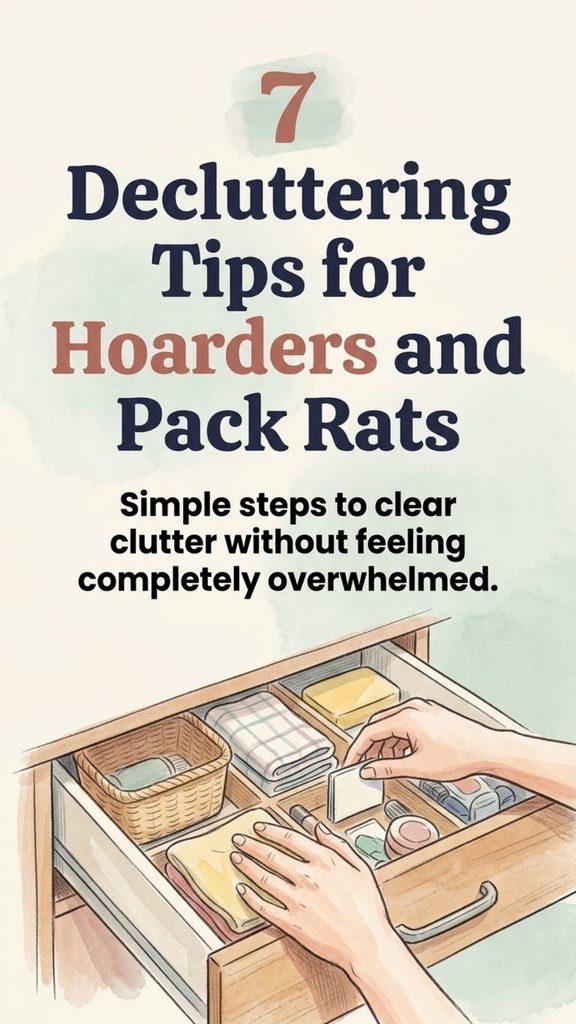
one kitchen drawer, one bathroom shelf, one nightstand, one small section of a closet, or the surface of one table.
The area should be small enough that you can completely finish it.
Finishing matters because half-sorted spaces often create more chaos than existed before. A successful small project also gives you evidence that the process is manageable.
Once one drawer is complete, you can move to the next.
Ten finished small areas are far more useful than one entire room pulled apart and abandoned halfway through.
3. Begin With Visible Clutter and Easy Decisions
Do not begin with childhood photographs, inherited possessions, important documents, or anything else carrying strong emotions.
Start with decisions that require very little thought.
Look for:
- obvious trash
- empty packaging
- expired items
- things that are broken beyond reasonable repair
- unusable pens and dried-out markers
- duplicates you clearly do not need
- items that belong in another room
- objects you already know you do not want
Removing these first accomplishes two things.
It creates visible space quickly, and it gives your brain practice making decisions before you reach difficult belongings.
Visible surfaces are particularly useful starting points. Clearing a kitchen counter or dining table can immediately restore a useful part of the room.
Do not expect every cleared surface to stay completely empty. The goal is for it to return to its intended function rather than becoming permanent storage.
4. Declutter Before You Organize
Buying organizers can feel like progress.
Sometimes it is. But storage products cannot solve a problem caused primarily by owning more possessions than the available space can comfortably hold.
A new basket can make fifty miscellaneous objects look neater without answering whether you need those fifty objects.
Reduce first.
Then organize what remains.
For example, instead of immediately buying extra shoe racks, review your shoes. Remove pairs that are worn out, uncomfortable, no longer fit, or are never used. Once you know how many pairs genuinely need storage, you can choose a system that fits them.
The same principle works with kitchen utensils, toiletries, clothing, paperwork, toys, tools, and hobby supplies.
Organizing is much easier when the amount being organized is reasonable.
5. Let Your Available Space Set the Limit
One of the hardest decluttering questions is:
“How many should I keep?”
Sometimes the physical space can answer for you.
Choose a reasonable container or boundary for each category.
For example:
- wrapping supplies fit in one bin
- everyday mugs fit on one cabinet shelf
- spare linens fit in one closet section
- sentimental letters fit in one memory box
- craft materials fit inside a designated cabinet
Then choose your favorites until that space is comfortably filled.
This approach changes the question from “Can I possibly justify keeping this?” to “Is this important enough to take one of the limited spaces available?”
That makes prioritizing easier.
The container should still be practical. Crushing possessions into overflowing boxes does not solve the problem. Items should be reasonably accessible, and drawers and doors should close normally.
6. Use Simple Questions Instead of Debating Every Item
People can spend several minutes inventing reasons to keep a single inexpensive object.
That becomes exhausting quickly.
Create a few questions and use them consistently.
Try asking:
Do I use this?
Not “Could I theoretically use it?” but whether it actually plays a role in your life.
Would I choose to bring this into my home again today?
This is especially useful for objects you have kept simply because you already own them.
Does it fit my current life?
Clothing, hobby materials, furniture, books, and equipment can all become connected to a lifestyle that no longer exists.
Do I have another item that already does the same job?
Duplicates are often easier to reduce than unique possessions.
Would replacing this be genuinely difficult?
Keeping a rare family document is very different from keeping twenty inexpensive containers because one might someday be useful.
You do not need to apply every question to every possession. They are tools for breaking through indecision when you become stuck.
For sentimental objects, use a different standard. Ask which items best preserve the memory rather than assuming every object connected to the memory must remain.
7. Get Help When the Job Is Bigger Than You Can Manage Alone
Decluttering does not have to be a solitary project.
A trusted friend or family member can help with practical tasks such as carrying donations, removing trash, moving boxes, or keeping the work area from becoming more chaotic.
The right helper should be calm and respectful. Someone who mocks your possessions or pressures you to discard things you are not ready to release may make the process harder.
There is also an important difference between ordinary household clutter and serious hoarding problems.
Hoarding disorder is a recognized mental health condition involving persistent difficulty discarding possessions, regardless of their actual value, along with accumulation that can interfere with the normal use of living spaces. Severe cases may also create problems involving sanitation, mobility, fire safety, pests, or access to exits and essential parts of the home.
If possessions are preventing rooms from being used normally, creating safety hazards, causing substantial distress, or leading to serious conflict with family members, simply following a decluttering checklist may not be enough.
Professional support can be useful, particularly from a qualified mental health professional familiar with hoarding problems. In situations involving serious physical hazards, additional help may be needed to make the home safer.
The aim should not be to force a dramatic cleanout as quickly as possible. Lasting improvement usually requires addressing both the possessions and the patterns that caused them to accumulate.
What to Do With Things You Decide to Remove
A surprisingly common problem is making good decluttering decisions but leaving the rejected items sitting inside the house.
A donation bag kept in the hallway for six months is still clutter.
Give outgoing items a clear destination.
Trash and recycling should leave as soon as practical. Donations should be placed near the exit and taken to the chosen organization promptly.
Be realistic about selling possessions.
An object may technically be worth money, but selling takes photographs, listings, messages, negotiations, packaging, and time. If an inexpensive item has been sitting unused for years, keeping it for another year while waiting for the perfect buyer may cost more in space and attention than the money you eventually receive.
Reserve selling for possessions whose value makes the effort worthwhile.
Avoid Creating a Giant “Maybe” Pile
A temporary undecided category can be useful, but it can also become a way to avoid making any decisions at all.
If you use a “maybe” box, keep it small and give yourself a specific point when you will review it again.
Another strategy is to photograph sentimental but bulky items before letting them go. A photograph does not replace every meaningful possession, but for some objects the memory matters more than the physical item.
Keep the best representatives of an experience rather than every object associated with it.
Focus on Function, Not Perfection
A decluttered home does not need empty shelves and nearly bare rooms.
A functional home may still contain books, decorations, collections, hobby materials, family keepsakes, and plenty of everyday possessions.
The difference is that the belongings have reasonable boundaries.
You can sit on the chairs.
You can prepare food on the kitchen counters.
You can find important documents.
Closets can be opened without objects falling out.
Cleaning does not require moving dozens of piles first.
The rooms work.
That is a much more useful standard than trying to make your home resemble a minimalist photograph.
Small Decisions Can Produce Big Changes
If clutter has accumulated for years, expecting to reverse it in one weekend creates unnecessary pressure.
Start by controlling what comes in. Choose one small area. Remove the obvious things first. Reduce before organizing. Give categories clear limits. Use simple questions when decisions become difficult, and seek support when the situation is more than you can reasonably handle alone.
Then repeat the process.
One drawer may not seem significant when an entire house needs attention, but a finished drawer is no longer part of the problem.
Then comes a shelf.
Then a counter.
Then a closet section.
Decluttering becomes much more manageable when you stop treating it as one enormous cleanup and start treating it as a series of small decisions about what deserves space in your life now.