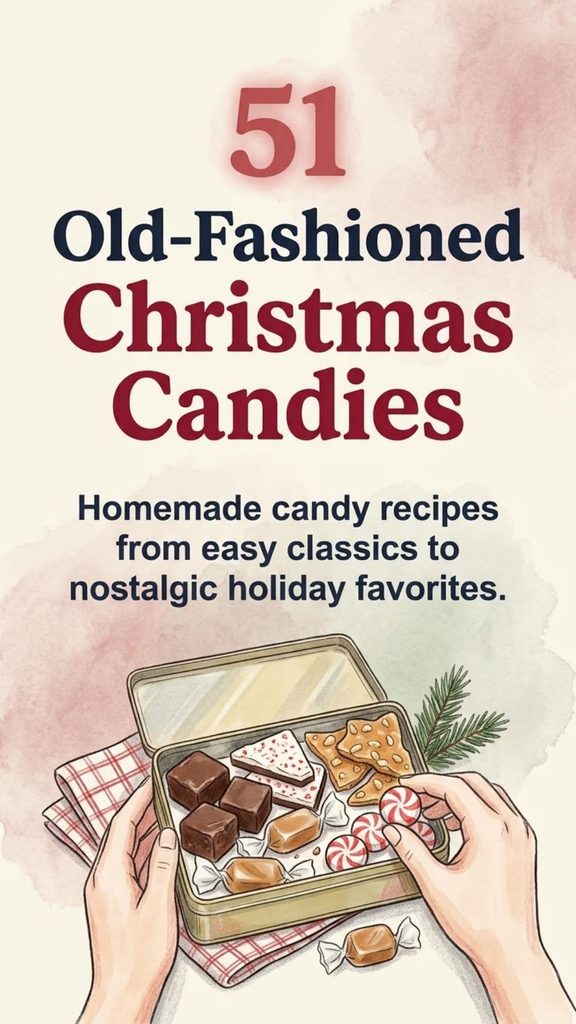
Homemade Christmas candy has a charm that store-bought sweets rarely match. A tin filled with buttery toffee, peppermint bark, fudge, caramels, nut clusters, and little hand-rolled truffles feels personal, generous, and wonderfully nostalgic.
It also doesn’t have to be complicated.
Some Christmas candies require nothing more than melting chocolate and mixing a few ingredients. Others introduce the traditional skills of sugar cookery: watching a thermometer, controlling crystallization, pulling hot candy, or cooking syrup to exactly the right stage.
You Might Also Like:
- Loading posts...
That makes holiday candy making easy to grow into. Start with chocolate clusters or peppermint bark, then try fudge, caramel, brittle, or pulled candy once you feel comfortable.
Not every sweet on this list is historically old-fashioned—Oreo truffles and slow-cooker candy are clearly more modern—but all of them fit the homemade Christmas-candy tradition beautifully.
A Few Candy-Making Basics Before You Start
Traditional cooked candy is less mysterious once you understand what the thermometer is telling you.
As sugar syrup cooks, water evaporates and the sugar concentration increases. Different concentrations produce different textures after cooling. Around sea level, common stages include soft ball at roughly 234–240°F, firm ball around 244–248°F, hard ball around 250–266°F, soft crack around 270–290°F, and hard crack around 300–310°F. Fudge and fondant generally fall into the softer ranges, caramels cook somewhat higher, and brittle and hard candy need much higher temperatures.
A few pieces of equipment make traditional candy much easier:
- A heavy, reasonably deep saucepan
- An accurate candy thermometer
- A heat-resistant spoon or spatula
- Parchment paper or prepared pans
- A sharp knife or kitchen scissors for cutting certain candies
- Plenty of counter space before the hot syrup is ready
Altitude matters too. Because water boils at a lower temperature as elevation rises, candy recipes written for sea level may need a lower finishing temperature. Colorado State University Extension recommends reducing the target by about 2°F for every 1,000 feet above sea level, or checking the local boiling point of water and adjusting from there.
With those basics covered, there is an enormous range of Christmas candy you can make at home.
Easy Christmas Candies for Beginners
These are good choices when you want homemade candy without spending the afternoon watching a thermometer.
1. Cream Cheese Mints
Cream cheese mints are soft, creamy, and pleasantly refreshing after a heavy holiday meal. They can be colored to match a Christmas tray and shaped into small rounds, flattened discs, or molded pieces.
Because these contain dairy, follow the storage directions for the particular recipe you use rather than assuming they can sit indefinitely at room temperature.
2. Crockpot Christmas Candy
Slow-cooker candy is ideal when you need a large batch with very little active work.
Chocolate and peanuts are gently melted together, then spooned into small clusters and decorated before they set. The contrast between smooth chocolate and salty nuts makes this particularly good for gift tins.
3. Peanut Butter Balls With Crispy Rice Cereal
Peanut butter balls become lighter and more textured when crisp rice cereal is mixed into the filling.
Roll the centers, chill them until firm, and coat them in chocolate. They are especially practical for holiday trays because the pieces are small, easy to portion, and familiar enough to please almost everyone.
4. Buckeye Balls
Buckeyes use a sweet peanut butter center coated partially in chocolate, leaving a circle of peanut butter visible on top.
They have the same satisfying chocolate-and-peanut-butter combination as many popular candy bars, but their handmade appearance makes them feel much more at home in a Christmas candy box.
5. Peppermint Bark
Few homemade candies give you this much holiday impact for so little work.
A typical peppermint bark combines chocolate, white chocolate, peppermint flavor, and crushed candy canes. Once firm, the slab is broken rather than carefully sliced, so uneven pieces are part of the appeal.
6. Coconut Balls
Simple coconut candies bring a chewy texture and snowy appearance to a tray full of chocolate and caramel.
They are especially useful when you want something that can be rolled and prepared without cooking sugar syrup. Some versions are chocolate-dipped, while others are left completely white.
7. Christmas Marshmallow Treats
Crispy cereal and marshmallow treats may not be traditional candy-shop confections, but shaping them into bite-sized balls gives them a festive candy-tray feel.
Christmas sprinkles or restrained red-and-green decorations are enough. There is no need to overload them with extra toppings.
8. Almond Bark
Chocolate-style bark is one of the easiest candies to customize.
Combine melted white confectionery coating or properly melted white chocolate with toasted almonds, spread it out, allow it to firm, and break it into rough pieces.
A small amount of salt can help balance the sweetness.
9. White Chocolate Truffles
White chocolate truffles have a rich, creamy center that pairs well with vanilla, citrus, nuts, coconut, or contrasting dark chocolate.
The trick is allowing the truffle mixture enough time to become firm before rolling. If it becomes too warm while you work, return it to the refrigerator briefly.
10. Dark Chocolate Truffles
A basic chocolate ganache can become an elegant Christmas candy with remarkably little effort.
Once chilled, the mixture can be portioned and rolled in cocoa powder, chopped nuts, coconut, or other suitable coatings.
Use chocolate you actually enjoy eating—the flavor of the finished truffle depends heavily on it.
11. Candied Pecans
Candied pecans add welcome crunch to a tray dominated by soft fudge and chocolate.
Depending on the recipe, they can be cooked on the stovetop or baked with a sweet coating. Cinnamon is a natural holiday addition, but the nuts themselves should remain the main flavor.
12. Peppermint Patties
A cool peppermint center coated in chocolate is one of the cleanest flavor combinations on a Christmas tray.
These are easier than they look because the center is generally mixed and shaped rather than cooked like traditional fondant. Chilling the rounds before dipping helps them hold their shape.
13. Gumdrops
Homemade gumdrops bring bright color and chewy texture to a candy assortment.
Once the mixture has set, the candy is cut into cubes or festive shapes and rolled in granulated sugar. Give the pieces enough time to firm before packing them so they do not stick together.
14. Chocolate-Covered Marshmallows
Large marshmallows dipped in chocolate are almost impossible to mess up.
They can be decorated with crushed peppermint, nuts, sprinkles, or a contrasting chocolate drizzle. Keep the decorations restrained if they are going into a mixed gift box—the chocolate coating already provides plenty of sweetness.
15. Lemon Coconut Balls
Lemon and coconut make a nice break from the heavier flavors of chocolate, caramel, and peanut butter.
These soft candies are typically rolled into small balls and coated in shredded coconut. Fresh lemon zest provides a more aromatic citrus character than sweetness alone.
16. Oreo Truffles
Crushed sandwich cookies and cream cheese make a soft truffle center that can be rolled and dipped in chocolate.
For Christmas, peppermint or crushed candy cane can be incorporated carefully, but the basic version already works well.
Because cream cheese is involved, store these according to safe refrigeration guidance for the recipe you follow.
17. Chocolate Peanut Clusters
Chocolate peanut clusters prove that a good candy does not need complicated technique.
Melt the chocolate, combine it with peanuts, spoon out individual portions, and let them set. Salted peanuts are particularly good at balancing sweet chocolate.
18. Mint Chocolate Fudge
Not every fudge needs traditional sugar-cooking technique.
Simplified mint-chocolate versions often rely on chocolate and other ingredients that set as they cool, producing smooth squares without the crystallization management required by old-fashioned boiled fudge.
19. Chocolate-Covered Bacon
This is the odd one on the tray—and often the first thing people ask about.
Very crisp bacon can be paired with chocolate for an intensely salty-sweet candy. It is best made in small quantities and treated as a novelty rather than the foundation of your Christmas assortment.
20. Gingerbread Truffles
Crushed gingersnaps make an excellent holiday truffle because the spices already bring notes of ginger, cinnamon, and molasses.
Once mixed into a soft filling, the centers can be dipped in chocolate and decorated simply.
21. Malted Milk Balls
Homemade malted candies offer the familiar flavor of malted milk powder with a softer homemade texture than many commercial malt balls.
A chocolate coating keeps them candy-box friendly and gives a nice snap against the softer center.
22. Lemon Truffles
Lemon truffles are another good way to lighten a rich Christmas selection.
Cookie-based versions combine a soft citrus filling with white chocolate on the outside. Lemon zest can provide plenty of fragrance without turning the center excessively wet.
Fudge, Maple Candy, and Creamy Confections
These recipes introduce more traditional candy-making skills, particularly temperature control and crystallization.
23. Maple Nut Fudge
Maple and walnuts naturally suit cold-weather baking and candy making.
A creamy maple fudge provides a softer, sweeter contrast to brittle and hard candy, while toasted walnuts add enough texture to prevent each bite from feeling overly rich.
24. Vanilla Fudge
Vanilla fudge looks plain, but making a truly smooth old-fashioned version teaches an important candy-making lesson: texture matters as much as flavor.
Traditional fudge is cooked, cooled, and then beaten so that very small sugar crystals develop. Poor temperature control or disturbing the mixture at the wrong stage can produce graininess.
25. Classic Chocolate Fudge
Old-fashioned cocoa fudge is very different from quick recipes made primarily by melting chocolate with condensed milk or marshmallow creme.
Traditional versions depend on careful cooking and controlled crystallization. It is a worthwhile recipe to master because the same principles apply to many other classic candies.
26. Peanut Butter Fudge
Peanut butter brings fat, flavor, and a softer character to fudge.
Traditional versions still reward accurate temperature measurement and careful timing. Resist the temptation to judge doneness only by appearance if the recipe specifies a target temperature.
27. Maple Candy
Traditional maple candy is one of the purest expressions of maple flavor.
The syrup is concentrated, cooled, and worked until its texture changes from a clear syrup into an opaque candy that can be shaped or poured into molds.
It is simple in ingredients but sensitive to temperature and timing.
28. Mocha Fudge
Chocolate and coffee deepen one another, making mocha fudge especially good for adults who prefer their Christmas candy less one-dimensionally sweet.
Depending on the recipe, espresso powder or strong coffee flavor can be incorporated into a traditional or quick-set fudge base.
Caramels and Butterscotch
Caramel making requires attention, but the process becomes much less intimidating once you understand that the final temperature largely determines the texture.
29. Maple Caramels
Maple caramels combine the buttery chew of caramel with the darker, woodsy sweetness of maple.
A candy thermometer is strongly recommended. Stop the cooking too early and the pieces may remain too soft to wrap; go too far and they can become unpleasantly hard.
30. Soft Caramels
A properly made soft caramel should hold its shape while remaining comfortably chewy.
Caramel recipes vary, so use the target temperature given in the recipe rather than assuming every caramel should be cooked identically.
Once completely cool, individually wrapped pieces make excellent homemade gifts.
31. Fireball Whiskey Caramels
Cinnamon-flavored whiskey gives these caramels a distinctly adult holiday character.
Alcohol-based candy should be clearly identified when gifting. Do not assume all alcohol disappears during cooking; how much remains depends on the recipe, temperature, cooking time, and method.
32. Butterscotch Squares
Butterscotch centers rely on the deeper flavor of brown sugar, often paired with butter and dairy ingredients.
After the filling firms, cutting it into neat squares and coating the pieces in chocolate transforms a simple cooked candy into something that looks as if it came from a confectionery box.
33. Apple Cider Caramels
Reducing apple cider before incorporating it into caramel concentrates the fruit flavor without adding excessive water.
Cinnamon, nutmeg, or cloves can reinforce the apple-cider character, but use spices thoughtfully. You still want caramel and apple to be recognizable.
Brittle, Toffee, and Aerated Candy
These candies move into hotter sugar territory. Prepare your pans and tools before you begin because once the syrup reaches temperature, there is rarely time to hunt for equipment.
34. Buttery English Toffee
Thin, buttery toffee topped with chocolate and nuts is one of the most impressive homemade Christmas candies.
Cooked to a crisp stage and poured into a thin layer, it cools into a hard sheet that can be covered with chocolate and chopped almonds before being broken into irregular shards.
35. Peanut Brittle
Classic peanut brittle should be crisp and easy to snap rather than thick and tooth-breaking.
The sugar mixture is cooked into the hard-candy range, peanuts are incorporated, and the hot mixture is spread quickly before it begins setting.
Have the pan ready before the candy reaches its final temperature.
36. Honeycomb Candy
Honeycomb candy gets its striking interior from bubbles created when baking soda reacts in the hot syrup.
The mixture expands rapidly, so use an appropriately sized pan and avoid touching or tasting it while hot.
Once cooled, it becomes crisp and airy, with a texture that is particularly good when paired with chocolate.
Hard Candies for a Traditional Christmas Candy Jar
Hard candy is straightforward in concept—concentrate sugar syrup until very little water remains—but the high temperature demands care.
Molten sugar can cause severe burns. Keep children away from the cooking pot and make sure everything you need is ready before reaching the hard-crack stage.
37. Butterscotch Hard Candy
Hard butterscotch delivers caramelized brown-sugar and butter flavors in a long-lasting candy.
Molds make portioning easier because the cooked syrup can be poured directly into individual shapes rather than cut while it is setting.
38. Lemon Drops
Old-fashioned lemon drops offer a sharp contrast to chocolate-heavy Christmas sweets.
The hard-candy syrup is flavored with lemon, cooled enough to handle according to the recipe, and shaped or cut into small pieces.
Working with hot pulled sugar is more demanding than simply pouring candy into molds, so this is best attempted after you have made basic hard candy successfully.
39. Cinnamon Rock Candy
Bright cinnamon candy looks almost like red stained glass.
Because it can simply be poured into a sheet and broken after cooling, it provides the flavor and texture of hard candy without requiring complicated shaping.
Strong cinnamon flavoring can be surprisingly intense, so measure according to a tested recipe rather than adding it casually.
40. Classic Hard Candy
Once you understand a basic hard-candy formula, changing the flavor can produce entirely different Christmas sweets.
Peppermint, cinnamon, orange, lemon, and anise are traditional possibilities. The essential skill is controlling the syrup temperature and handling it safely once it leaves the stove.
Pulled and Shaped Candies
These recipes require more timing and hands-on work. They are rewarding, but they are not the place to begin if you have never cooked sugar before.
41. Candy Canes
Homemade candy canes require hot sugar to be divided, colored, pulled, twisted, and shaped before it becomes too firm.
The syrup is cooked into the high-temperature hard-candy range, and the pulling stage gives the candy its opaque, satiny appearance.
Work efficiently and protect your hands according to the recipe instructions.
42. Saltwater Taffy
Despite the name, saltwater taffy is not made with seawater.
The cooked candy is pulled repeatedly as it cools, incorporating air and changing the texture and appearance. Once properly pulled, it is stretched, cut, and individually wrapped.
This is a fun group candy-making project because the pulling stage takes some effort.
43. Licorice
Homemade black licorice is quite different from ordinary hard candy.
Its chewy texture and distinctive anise-forward flavor make it one of the more unusual additions to a Christmas collection. This is especially good for households where licorice has devoted fans—people tend to have strong opinions about it.
Southern and Traditional Sugar Candies
These confections show just how different sugar can behave depending on how it is cooked, cooled, and beaten.
44. Divinity
Divinity is light, pale, and almost cloudlike when made correctly.
Hot sugar syrup is incorporated into whipped egg whites, creating a glossy mixture that is portioned before it sets.
Humidity can make divinity more difficult because the sugar readily attracts moisture from the air, so dry weather is traditionally preferred for making it.
45. Pecan Pralines
Southern-style pecan pralines combine cooked sugar with dairy and plenty of pecans.
They are neither smooth fudge nor crisp brittle. A good praline has its own distinctive tender, slightly crystalline texture.
Once the mixture reaches the correct stage, it can begin setting quickly, so arrange your work area before cooking.
Fruit, Jelly, and Gelled Candies
Not every old-fashioned candy is based on chocolate or caramel.
46. Jelly Slices
Homemade jelly candies add translucent color and soft chewiness to a Christmas assortment.
Once fully set, the slab can be cut into squares or other shapes and rolled in sugar. Letting the surface dry appropriately before packaging can help keep the coating from immediately dissolving into stickiness.
47. Turkish Delight
Traditional Turkish delight is more demanding than gelatin-based gumdrops.
Its characteristic tender, chewy texture comes from carefully cooking sugar and starch mixtures. Rose is perhaps the best-known flavor, although citrus and other variations are also common.
Expect a longer cooking process than with ordinary jelly candy.
Filled and Rolled Christmas Candies
These candies are about shaping, dipping, and presentation more than high-temperature sugar work.
48. Chocolate-Covered Cherries
Chocolate-covered cherries combine fruit, a sweet surrounding filling, and a chocolate shell.
Different recipes create different center textures, so follow the formula closely rather than improvising substitutions. Finished candies benefit from careful dipping so the chocolate shell completely encloses the filling.
49. Southern Bourbon Balls
Bourbon balls commonly combine crushed cookies or wafers, cocoa, nuts, and bourbon into a soft rolled confection.
There is usually little cooking involved, which makes them easy, but they are intended for adults. Label them clearly when putting together mixed gift boxes.
50. Tiramisu Truffles
Tiramisu truffles bring coffee, chocolate, and dessert-like richness into a bite-sized candy.
Recipes may use espresso flavor, chocolate, creamy ingredients, and Marsala or another flavor component inspired by tiramisu.
If alcohol is included, identify the candies when serving or gifting them.
51. Marzipan
Marzipan deserves a place in any collection of traditional Christmas sweets.
Made primarily from almonds and sugar, it can be shaped into simple candies, rolled into logs, dipped in chocolate, or molded into tiny decorative fruits.
It is one of the best options for someone who enjoys hand-shaping candy but does not want to work with dangerously hot sugar.
How to Build a Christmas Candy Box Without Making All 51
A beautiful homemade candy box does not need dozens of recipes.
In fact, five or six carefully chosen candies usually create more than enough variety. Think in terms of contrasting textures, colors, and flavors.
A balanced box might include:
- One creamy candy, such as fudge
- One crunchy candy, such as brittle or toffee
- One chocolate candy, such as truffles or peanut clusters
- One mint candy, such as peppermint bark or patties
- One chewy candy, such as caramel
- One nut or fruit candy for variety
This approach also makes candy-making week far more manageable.
Choose recipes that share ingredients when possible. Chocolate can cover truffles, marshmallows, peanut clusters, and peppermint patties. Pecans can go into pralines, fudge, and candied nuts. Peppermint can appear in bark, patties, or hard candy.
Common Candy-Making Mistakes
The most frequent mistake is treating candy like ordinary stovetop cooking.
Once sugar reaches certain stages, a few degrees can dramatically change the finished texture. An accurate thermometer is far more reliable than deciding the mixture “looks done.”
Crystallization is another common problem. With candies such as fudge, uncontrolled crystal formation can create a coarse, grainy texture. Colorado State University Extension recommends techniques such as keeping unwanted sugar crystals off the sides of the pan and avoiding unnecessary disturbance during critical cooling stages.
Other mistakes include using a pan that is too small, beginning without preparing the molds or trays, cutting caramels before they are fully cool, overheating chocolate, and trying an advanced pulled candy before becoming comfortable with basic sugar syrup.
Start simple and build skill naturally.
Bring Back the Christmas Candy Tin
The best part of homemade Christmas candy is not making the most complicated recipe on the list. It is creating something that feels special enough to share.
A beginner can make an excellent gift box from peppermint bark, peanut clusters, truffles, candied pecans, and marshmallow treats without ever cooking a sugar syrup. Someone ready for a challenge can add fudge, pralines, caramels, brittle, divinity, or hand-pulled candy.
And once you understand how temperature changes sugar, many traditional recipes stop feeling mysterious.
Pick two or three candies that sound genuinely delicious, make them well, and write down what worked. Next Christmas, add another. Before long, that little tin of homemade sweets can become the kind of holiday tradition people look forward to every year.