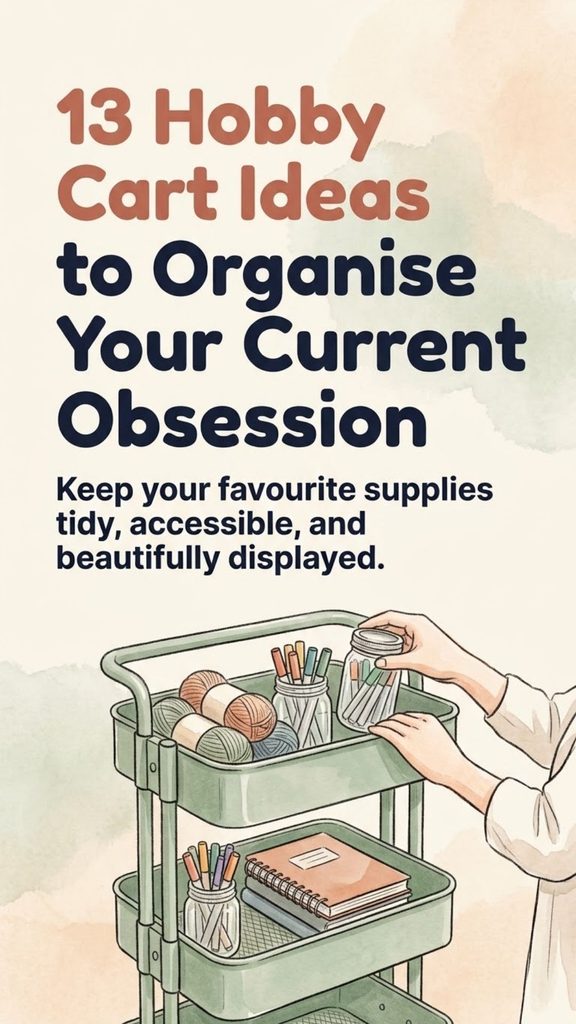
A hobby is much easier to enjoy when you can actually find the supplies you need. Yarn buried in a cupboard, markers scattered across several drawers, or half-finished projects stacked on the dining table can turn a relaxing pastime into another source of clutter.
A rolling hobby cart solves that problem without requiring a dedicated craft room. It gives your supplies a defined home, keeps frequently used tools within reach, and can move from a bedroom to the sofa, kitchen table, desk, or wherever you prefer to work.
The best hobby carts are not simply filled with supplies. They are organised around how the hobby is actually used. Everyday tools belong near the top, bulky or less-used items can sit lower down, and small accessories need containers so they do not disappear into the bottom of a basket.
You Might Also Like:
- Loading posts...
If you are looking for a practical way to organise your current creative obsession, these 13 hobby cart ideas offer plenty of inspiration.
What Makes a Good Hobby Cart?
Before choosing what to put on your cart, think about the cart itself.
A three-tier utility cart is popular because it provides plenty of vertical storage without taking up much floor space. Metal carts tend to be sturdy, while lightweight plastic versions may be easier to move. The best choice depends on what you plan to store.
Look for features such as:
- wheels that roll smoothly on your flooring
- raised shelf edges so supplies do not fall out
- enough clearance between tiers for tall items
- hooks or rails for hanging accessories
- removable bins or cups
- lockable casters if the cart will hold heavier equipment
Check the manufacturer’s weight limits before loading a cart with books, a sewing machine, large paint containers, or other heavy supplies. Keeping heavier objects on lower shelves can also make the cart more stable.
Once you have the right base, you can turn it into almost any kind of portable hobby station.
1. Create a Rolling Home Library
A rolling book cart works particularly well for anyone whose reading pile seems to multiply faster than the books can be finished.
Use the top shelf for your current reads and the lower tiers for books you plan to read next. You could organise them by genre, author, series, size, or even colour if you enjoy a more decorative look.
Add a small container for reading accessories such as:
- bookmarks
- reading glasses
- sticky tabs
- highlighters
- a reading journal
- pens
Place the cart beside your favourite chair or bed and you have a compact reading station that can move whenever your reading spot changes.
Books become heavy surprisingly quickly, so avoid overloading a lightweight cart. Distributing the weight across the shelves rather than placing everything on the top tier will make it easier and safer to move.
2. Build a Mobile Skincare Station
If your bathroom counter is crowded with bottles and jars, a small rolling cart can create a more organised skincare setup.
Instead of arranging every product in one large group, divide the cart by routine.
For example:
Top tier: products used every day
Middle tier: masks, occasional treatments, and body care
Bottom tier: backups, towels, or larger bottles
Small bins help keep narrow bottles from falling over, while a tray can contain products that sometimes leak.
A mirror can turn the cart into a simple portable vanity, but skincare products still need appropriate storage. Products that are sensitive to heat or direct sunlight should be kept according to their label directions rather than displayed in a sunny area simply because it looks attractive.
3. Organise a Crochet Cart
Crochet supplies are almost made for rolling storage.
Yarn takes up plenty of room, hooks are easy to misplace, and works in progress have a habit of spreading across sofas and tables. A cart lets everything stay together.
Use separate tiers for:
- current yarn and works in progress
- reserve yarn
- tools and pattern materials
Small hanging cups or containers can hold crochet hooks, stitch markers, scissors, measuring tapes, tapestry needles, and row counters.
If you work with several yarn colours at once, dividers or individual bins can prevent skeins from becoming tangled together.
One useful rule is to keep only active-project yarn on the cart. Store the rest of your yarn collection elsewhere if necessary. Otherwise, a project cart can quickly become an overflowing yarn cart.
4. Make a Mobile Artist’s Studio
Painting and drawing involve dozens of small tools, so a cart can function as a compact studio for anyone without a permanent art desk.
Keep frequently used brushes, pencils, or pens upright in jars or sturdy cups on the top tier. Paints can occupy the middle shelf, while sketchbooks, palettes, pads, and other larger items can go below.
The goal is not to place every art supply you own on the cart. Instead, create a working collection containing the materials you actually reach for.
For paint supplies, it is also worth keeping a separate container for dirty brushes or tools until they can be cleaned. Avoid placing wet brushes directly against paper, sketchbooks, or finished artwork.
5. Create a Dedicated Project Cart
Sometimes it makes more sense to organise by project rather than by hobby.
A project cart is especially useful for crafts that take several days or weeks to complete, such as crochet blankets, embroidery, quilting, scrapbooking, miniature building, or handmade decorations.
Keep the active project on the top shelf so you can stop and restart without rebuilding your workspace every time.
The middle shelf can hold the materials needed for the next stage, while the bottom shelf stores tools and extras.
This approach also helps prevent unfinished projects from becoming mixed together. If you tend to start several things at once, consider placing each project in its own labelled bag or bin before putting it on the cart.
6. Combine Sewing Storage With a Pressing Station
Sewing often involves repeatedly moving between the sewing machine and an ironing board to press seams. In a small room, a compact cart can help keep those tasks closer together.
A sturdy cart can store thread, scissors, pins, measuring tools, fabric pieces, and pressing accessories. Some crafters also create a heat-resistant pressing surface that fits over the top.
If you decide to add a pressing board, safety matters more than appearance. The surface should be designed to tolerate heat, remain stable during use, and not interfere with the cart’s balance.
Never assume that an ordinary cart top is safe for a hot iron, and do not leave an iron unattended on a mobile surface.
7. Set Up a Watercolour and Painting Cart
A painter who uses watercolour, acrylics, gouache, ink, or several different media can organise a cart by material type.
One possible arrangement is:
Top: current palette, favourite brushes, and most-used colours
Middle: paints grouped by medium
Bottom: paper, sketchbooks, masking tape, palettes, and backups
Hanging cups on the side are especially useful for brushes and pens because they leave shelf space available for larger items.
Keep lids secure and store paints according to their manufacturer’s recommendations. An organised cart is helpful, but it should not become a place where wet palettes or open containers are forgotten after a painting session.
8. Make a Marker and Coloured Pencil Cart
Anyone who enjoys colouring, illustration, journaling, or hand lettering can quickly accumulate dozens of markers and pencils.
Containers make the biggest difference here.
Use separate cups for categories such as:
- coloured pencils
- fineliners
- brush pens
- gel pens
- markers
- erasers and sharpeners
You can organise further by colour family if you have a large collection.
Before choosing upright storage for markers, check the manufacturer’s recommendations. Some markers are intended to be stored horizontally, while storage requirements can vary depending on the ink and pen design.
The lower tiers can hold colouring books, sketchbooks, paper, and reference materials.
A small decorative object or plant can make the cart feel more like part of the room, but leave enough working space that decoration does not compete with storage.
9. Turn a Cart Into a Reading Nightstand
A hobby cart does not have to support just one activity.
A cart beside the bed can combine reading materials with a few nighttime essentials, creating a flexible alternative to a traditional nightstand.
You might keep:
- your current books
- a reading journal
- hand cream
- glasses
- tissues
- headphones
- a small book light
- bookmarks
A battery-powered decorative light can add a cosy touch without creating another trailing power cord. If you do use powered lighting, keep cords clear of the cart’s wheels and walking paths.
The advantage of this setup is flexibility. If you decide to read in another room, the whole station can move with you.
10. Build a Mobile Sewing Station
A sewing cart can make a small sewing setup considerably easier to manage.
The top can hold frequently used tools, while lower shelves organise fabric, patterns, thread, interfacing, rulers, and accessories. Side hooks or racks can make good use of otherwise wasted vertical space.
A sewing machine can sometimes be stored or transported on a sufficiently sturdy cart, but do not assume every utility cart can safely support one. Sewing machines vary in weight, and a machine placed high on a narrow cart can make the cart top-heavy.
Check the cart’s rated capacity, use locking wheels if available, and move the machine to a stable work surface before sewing unless the setup has specifically been designed for that purpose.
11. Create a Mixed-Media Hobby Cart
Not everyone wants to commit to one craft.
If one week you are drawing and the next you are embroidering, a mixed-media cart may make more sense than several separate storage systems.
Assign each shelf a category.
For example:
Top: drawing and colouring
Middle: embroidery or hand sewing
Bottom: paper crafts and miscellaneous supplies
Use containers within each shelf so categories remain separate.
The biggest danger with a multi-hobby cart is turning it into a miscellaneous dumping ground. Give every item a specific location and periodically remove supplies belonging to hobbies you are no longer using.
12. Build an All-in-One Craft Station
For a broad collection of general craft supplies, use every part of the cart rather than relying only on the shelves.
The tiers can hold paper, paint, glue, notebooks, and larger tools. Hanging cups can contain pencils and scissors. Hooks can hold rulers, tape, or lightweight accessories. Narrow side bins are useful for items that would otherwise become buried.
A good general craft cart often works best when organised by frequency rather than by product type.
Keep the things you use constantly at hand level. Less-used supplies can go toward the bottom.
Clear or open containers also help because you can see what you already own before buying duplicates.
13. Make a Multi-Passion Cart
If your hobbies change with your mood or the season, create a cart designed specifically for rotating interests.
One tier might contain a current novel and journal. Another could hold drawing supplies. The final shelf could house a small crochet or paper-craft project.
Hooks, dividers, and removable bins make this arrangement much easier because the cart can change whenever your interests do.
You do not need to store your entire hobby collection here. Think of the cart as a rotating selection of what you are enjoying right now.
When a project ends, clear that section and replace it with the next one.
This keeps the cart useful instead of allowing old hobbies to slowly bury the new ones.
How to Keep a Hobby Cart Organised
Creating the cart is the enjoyable part. Keeping it organised requires a little restraint.
A few habits make a noticeable difference.
Keep the Top Tier for Active Supplies
The easiest shelf to reach should contain whatever you use most often. If you have to dig through storage boxes before every session, the cart is not saving you much effort.
Give Small Items Containers
Loose stitch markers, pencils, paint tubes, clips, erasers, thread, and other small supplies quickly create visual clutter.
Cups, jars, drawer inserts, and small bins give those items boundaries.
Avoid Overfilling the Cart
A hobby cart works best when you can see and reach its contents.
If every shelf is packed to the point where you have to remove five objects to reach one, move part of the collection into longer-term storage.
Leave Room for Work in Progress
One of the greatest benefits of a hobby cart is being able to stop halfway through a project without leaving everything on a table.
Reserve a shelf or basket specifically for unfinished work.
Reset It Occasionally
Hobbies evolve. Supplies get used up, projects end, and new interests appear.
Every few weeks or at the end of a major project, remove rubbish, put stray items back where they belong, and decide what genuinely deserves a place on the cart.
Small-Space Hobby Storage Can Still Feel Creative
You do not need a craft room, studio, or wall of built-in storage to create an enjoyable hobby setup. A simple rolling cart can provide enough space for a carefully chosen collection of books, yarn, paints, sewing supplies, skincare, drawing tools, or several hobbies at once.
The most successful cart is not necessarily the prettiest or the fullest. It is the one that makes starting your hobby easier.
Keep everyday tools accessible, contain small items, respect the cart’s weight limits, and leave enough empty space to actually use what you own. With those basics in place, a small mobile cart can become one of the most useful pieces of storage in your home.