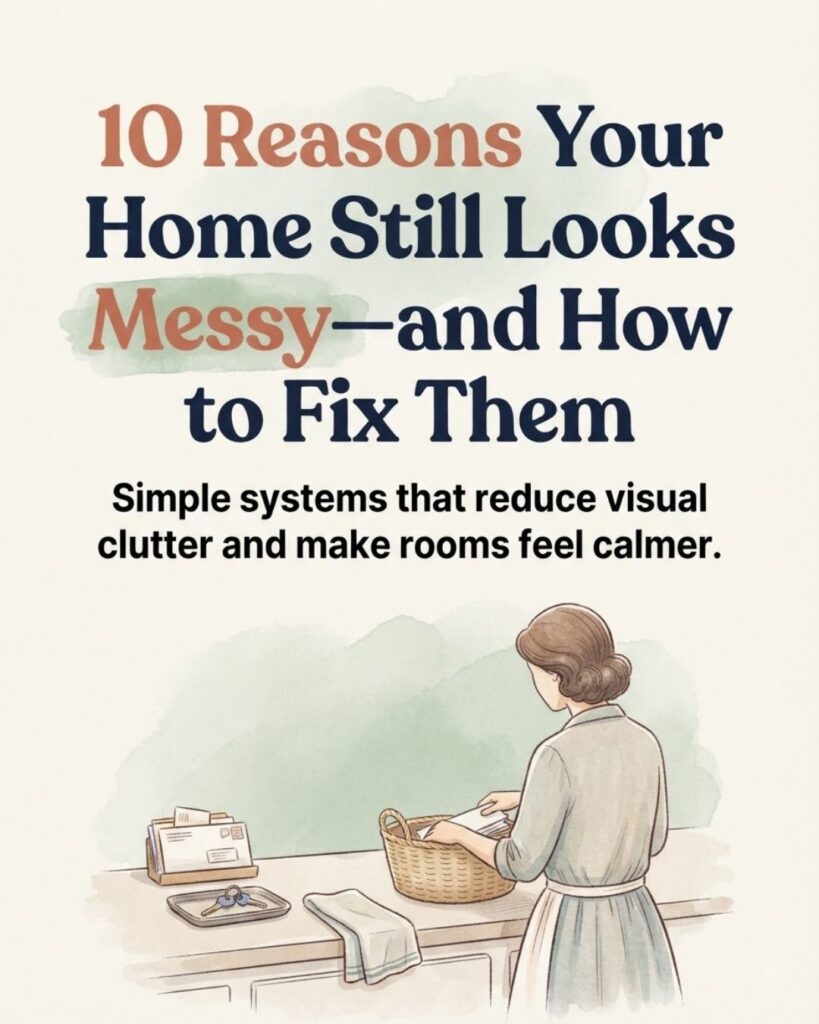
A home can be freshly cleaned and still look untidy. You may have wiped the counters, vacuumed the floors, and cleaned the bathroom, yet something about the space still feels chaotic.
The problem is often not dirt. It is visual clutter.
Objects left on open surfaces, overflowing baskets, scattered shoes, paperwork, and too many decorative items can make a room appear disorganized even when it is technically clean. The good news is that many of these problems do not require hours of deep cleaning. Small systems and a few consistent habits can make a noticeable difference.
You Might Also Like:
- Loading posts...
Here are ten common reasons a home looks messy, along with practical ways to bring back a calmer, more organized appearance.
1. Flat Surfaces Have Become Drop Zones
Kitchen counters, dining tables, dressers, coffee tables, and entryway consoles naturally attract everyday items. Keys get dropped beside the door. Mail lands on the counter. Chargers, receipts, water bottles, toys, and shopping bags slowly collect until the surface disappears underneath them.
Because large horizontal surfaces are highly visible, even a relatively small amount of clutter can make an entire room feel disorganized.
The goal does not need to be completely empty countertops. Instead, decide what genuinely deserves to stay there.
A few simple systems can help:
- Place a small tray near the entrance for keys and wallets.
- Create a designated charging station for phones and electronics.
- Keep frequently used kitchen appliances together rather than scattered across every counter.
- Use a basket for items that need to be returned to another room.
- Remove objects that have no clear purpose in that space.
Before buying organizers, reduce what is sitting out. Containers can organize belongings, but they cannot solve the problem of simply having too much on display.
Try resetting the most visible surfaces at the end of each day. Even five minutes can dramatically change how the room feels the next morning.
2. The Bed Is Left Unmade
The bed is usually the largest object in a bedroom, so its appearance influences the whole room.
A bedroom with clean floors and organized furniture can still look untidy if sheets are twisted, blankets are hanging over the edge, and pillows are scattered around.
Fortunately, making a bed does not need to involve arranging decorative pillows like a hotel display.
Straighten the sheets, pull up the blanket or comforter, and place the sleeping pillows back where they belong. That alone creates a large area of visual order.
If making the bed feels unnecessarily complicated, simplify the bedding. Fewer decorative pillows, easy-to-manage blankets, and washable bedding can make the daily routine faster.
The goal is not perfection. It is creating one large, calm visual anchor in the room.
3. Laundry Is Always Visible
Laundry has a way of making several areas messy at once.
Dirty clothes may accumulate on the bedroom floor. Hampers overflow. Clean laundry sits unfolded in baskets. Towels hang over chairs while unmatched socks wait indefinitely for their partners.
The problem often comes from a laundry system that does not match the household’s actual routine.
Instead of waiting until laundry becomes a major project, create a rhythm that keeps it manageable. Some households prefer doing one load every day or two, while others find that assigning specific laundry days works better.
What matters is having a predictable routine.
You can also make the system easier by placing hampers where clothes are actually removed rather than where you think they should be. If clothes consistently end up beside the bed, for example, that may be the best place for a hamper.
Lidded baskets can reduce visual clutter, but they should not become permanent storage for clean clothes. Try to complete the entire cycle—wash, dry, fold, and put away—rather than stopping halfway.
4. Your Shelves Are Too Crowded
Bookshelves and open shelving can add character to a home, but they also display everything placed on them.
When every inch is filled with books, framed photos, souvenirs, baskets, candles, plants, and decorative objects, the eye has nowhere to rest. The result can feel cluttered even when every item has technically been arranged.
Start by removing everything that does not need to be displayed.
Books can be arranged in several ways. Grouping them by subject may be most practical, while arranging similar sizes together can create a cleaner visual line. There is no rule requiring books to be sorted by color unless you genuinely find that useful.
Leave some open space instead of filling every gap.
If you enjoy displaying collections, consider rotating them. A few favorite pieces can receive more attention when they are not competing with dozens of other objects.
Open shelving works best when it combines useful storage with intentional display rather than functioning as a place for everything that lacks another home.
5. Shoes Take Over the Entrance
The entrance creates the first impression of a home, and scattered footwear can make that area look chaotic very quickly.
A household does not need an elaborate mudroom to control shoe clutter. What it needs is a clearly defined place for everyday footwear.
Depending on the available space, that might be:
- A small shoe rack
- A bench with storage underneath
- A narrow cabinet
- Individual baskets for family members
- A boot tray for wet or muddy shoes
Consider limiting the entryway to shoes currently being worn regularly. Seasonal footwear, formal shoes, and rarely used pairs can be stored elsewhere.
A good entryway system should also be convenient. If putting shoes away requires walking upstairs and opening several containers, people are much more likely to leave them by the door.
Making the tidy option the easiest option usually works better than relying on constant reminders.
6. Paper Keeps Multiplying
Paper clutter develops quickly because many pieces seem temporarily important.
Bills, receipts, school notices, appointment cards, advertisements, instruction manuals, coupons, and unopened mail can collect on kitchen counters and desks before anyone decides what to do with them.
The most effective strategy is to give incoming paper an immediate destination.
When mail enters the house, sort it into simple categories:
- Recycle or discard.
- Take action.
- File or keep.
Avoid creating a large miscellaneous pile to deal with later.
Where appropriate, switching to electronic statements or digital documents can reduce the amount of paper entering the home. However, digital storage needs organization too. Saving everything to an overflowing email inbox simply moves the clutter from one location to another.
For paperwork that must be kept, use a simple filing system with categories you actually understand. Complicated systems tend to be abandoned.
It is also wise to shred documents containing sensitive personal or financial information rather than placing them intact in household recycling.
7. The Kitchen Sink Is Rarely Empty
A pile of dishes is one of the quickest ways to make a kitchen appear messy because the sink is often located in a central, visible area.
The easiest solution is not necessarily washing every item immediately after use. That may be unrealistic in a busy household.
Instead, create a reliable routine for preventing dishes from accumulating for too long.
If you use a dishwasher, load items directly instead of leaving them beside the sink whenever possible. Run the dishwasher before it becomes so full that dirty dishes start collecting elsewhere.
If dishes are washed by hand, choose one or two consistent times each day to clear the sink.
Afterward, wipe the sink and surrounding counter. A clean, open sink makes the entire kitchen look noticeably more orderly.
Cooking also becomes easier when you begin with an empty sink rather than working around yesterday’s dishes.
8. Pet Supplies Are Spread Through the House
Pets naturally come with belongings: toys, leashes, grooming tools, food containers, blankets, bowls, and sometimes medications or training supplies.
Without designated storage, those items can migrate into every room.
A simple basket can hold toys in the main living area. Hooks near the door can keep leashes together. Grooming supplies can stay in one container rather than being spread across bathroom cabinets and drawers.
You may also find that your pet has accumulated far more toys than it regularly uses. Rotating a smaller selection can reduce clutter while still giving your pet variety.
Pet organization should also consider safety. Frequently used toys can remain accessible, but damaged toys or small loose pieces that could create hazards should be removed.
The goal is not to hide every sign that an animal lives in the home. It is simply to prevent pet belongings from becoming uncontrolled clutter.
9. There Is Too Much Decor
Decorating and clutter are not the same thing, but the line between them can disappear when too many objects compete for attention.
A mantel covered from edge to edge with figurines, multiple signs, candles, frames, garlands, and seasonal decorations may make the room feel visually busy rather than cozy.
You do not have to adopt a minimalist style to solve the problem.
Instead, be selective.
Choose decorative pieces that have meaning, add texture, introduce color, or support the overall look of the room. Give important items enough surrounding space to be noticed.
Grouping a few related objects often looks more intentional than distributing many small decorations across every surface.
Another useful approach is seasonal rotation. Rather than displaying everything you own throughout the year, store some pieces and bring them out periodically.
Reducing visual competition often makes favorite belongings stand out more, not less.
10. The House Is Organized but Looks Dusty
Clutter is not the only factor that influences how tidy a room appears.
Dust on furniture, crumbs on floors, pet hair, smudged mirrors, fingerprints on shiny surfaces, and debris along baseboards can make an otherwise organized home look neglected.
You do not need to deep-clean every room every day.
Focus regular cleaning on highly visible and heavily used areas. Vacuum or sweep floors as needed, wipe frequently touched surfaces, dust areas that collect visible buildup, and clean kitchen and bathroom surfaces on a consistent schedule.
Households with pets, children, open windows, or heavy foot traffic may need some tasks more frequently than others.
Rather than copying someone else’s strict cleaning schedule, build one around your own home. A small apartment occupied by one person has very different cleaning demands from a busy family home.
Consistency usually matters more than having a complicated routine.
Why Cleaning Alone Does Not Solve the Problem
One of the most frustrating parts of maintaining a home is cleaning repeatedly without seeing lasting improvement.
That often happens because cleaning and organizing are different tasks.
Cleaning removes dirt.
Organizing decides where belongings belong.
Decluttering removes belongings you no longer need.
A home may require all three.
For example, wiping a crowded kitchen counter makes the objects sitting on it cleaner, but it does not make the counter look less cluttered. Buying attractive baskets may hide some belongings, but if those baskets contain items nobody uses, the underlying problem remains.
Whenever an area repeatedly becomes messy, look for the reason rather than simply cleaning it again.
Maybe the trash can is too far away.
Maybe there is no place for incoming mail.
Maybe the family owns more shoes than the entryway can realistically hold.
Maybe clean laundry stays in baskets because dresser drawers are overcrowded.
Repeated mess is often useful information. It shows where the household system is not working.
Create Small Reset Habits Instead of Constantly Deep Cleaning
A consistently tidy-looking home usually depends more on short routines than occasional cleaning marathons.
Consider a simple daily reset.
Spend a few minutes returning frequently misplaced objects to their homes, clearing the kitchen sink, straightening the main living area, and preparing clutter-prone surfaces for the next day.
You can also use a “take something with you” habit. When leaving a room, look for one item that belongs where you are going. A mug can travel back to the kitchen. Shoes can return to the entryway. A book can go back on its shelf.
These tiny actions prevent dozens of small objects from accumulating into a larger job.
Just as importantly, make sure every frequently used object has a realistic home. If something constantly ends up on the counter, ask where you naturally look for it and create storage nearby.
An organized home should work with everyday behavior, not fight against it.
A Tidier Home Starts With Better Systems
A house does not need to look perfectly staged to feel calm and welcoming. People live there, meals get cooked, clothes get worn, children play, pets leave toys around, and everyday life creates temporary mess.
The difference between temporary mess and constant clutter often comes down to whether belongings have somewhere easy to return.
Start with the areas that have the biggest visual impact: clear the main surfaces, make the bed, control laundry, manage incoming paper, clear the sink, and give shoes and everyday items designated homes.
Then simplify anything that repeatedly becomes difficult to maintain.
The most effective home organization systems are rarely the most complicated ones. They are the ones that are easy enough to use every day. When your home is set up around realistic habits, keeping it tidy becomes less about repeatedly cleaning up chaos and more about preventing that chaos from building in the first place.