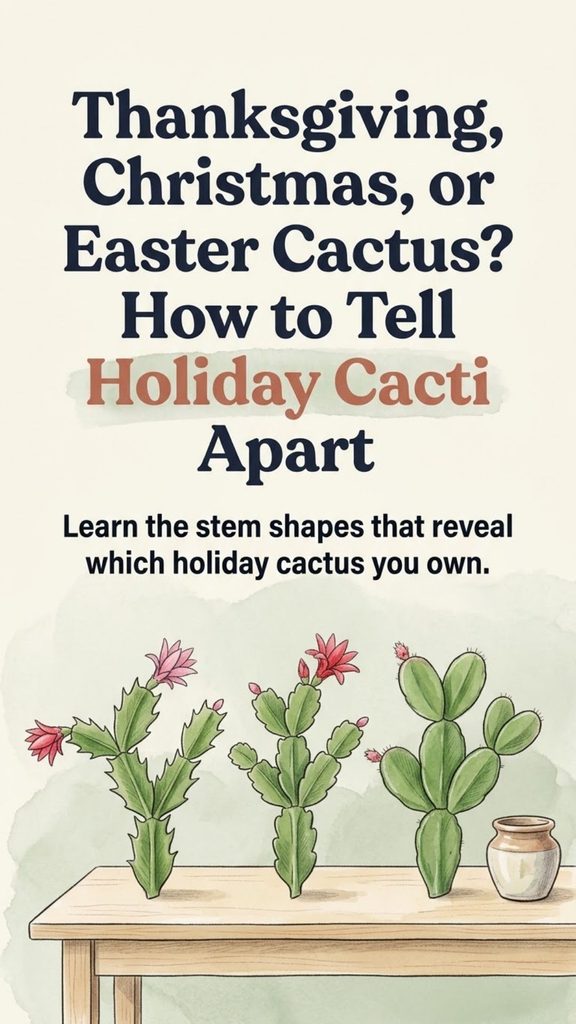
Holiday cacti are easy to confuse. A plant sold as a “Christmas cactus” may actually be a Thanksgiving cactus, while an Easter cactus can look remarkably similar when the plants are not flowering.
The good news is that you do not need to wait for flowers to identify them. One of the most useful clues is the shape of the flattened green stem segments.
Thanksgiving cactus has noticeably pointed, claw-like edges. Christmas cactus has softer, rounded scallops. Easter cactus generally has broader, rounded segments and may show tiny bristles around the tips.
You Might Also Like:
- Loading posts...
Once you know these differences, identifying holiday cacti becomes much easier.
Those Green “Leaves” Are Actually Stems
The flat green sections on holiday cacti are not true leaves. They are modified stem segments that perform photosynthesis and connect together to form the plant’s arching branches.
These segments are one of the best identification features because flowering time can vary.
Temperature, indoor lighting, greenhouse production, and general growing conditions can all influence when a holiday cactus develops buds. That means a cactus flowering in December is not automatically a true Christmas cactus.
For identification, look at the plant itself before relying on the calendar.
The three commonly confused holiday cacti are:
- Thanksgiving cactus
- Christmas cactus
- Easter cactus
Their growth habits are similar, but their stem shapes and flowers provide useful clues.
1. Thanksgiving Cactus: Sharp, Pointed Edges
The Thanksgiving cactus is usually the easiest of the three to recognize.
Look closely at the edges of one mature green segment. You should see several distinct pointed projections.
These projections may resemble little teeth, hooks, or crab claws. This is why Thanksgiving cactus is sometimes called crab cactus.
How to Identify a Thanksgiving Cactus
Look for:
- Flat, connected green stem segments
- Clearly pointed edges
- Several tooth-like projections along each segment
- An angular or claw-like appearance
- Flowers that often extend outward from the plant
The flowers can appear in many colors, including pink, red, orange, white, purple, and combinations of these shades.
Thanksgiving cactus generally begins flowering earlier than the true Christmas cactus, commonly during late fall and early winter.
However, flowering time should only be used as an additional clue.
Why a “Christmas Cactus” May Actually Be a Thanksgiving Cactus
This is surprisingly common.
Thanksgiving cactus is widely grown commercially and is often sold during the Christmas shopping season. Because “Christmas cactus” is such a familiar name, plants with clearly pointed Thanksgiving-cactus segments may still be labeled as Christmas cacti.
If your plant has sharp, crab-claw-like projections along the sides of its segments, it is probably a Thanksgiving cactus regardless of what the store tag says.
2. Christmas Cactus: Soft, Rounded Scallops
A true Christmas cactus has noticeably softer-looking stem edges.
Instead of the pointed projections seen on Thanksgiving cactus, the edges form gentle rounded scallops.
There may still be visible lobes, but their ends are curved rather than pointed.
How to Identify a Christmas Cactus
Look for:
- Flattened, connected green segments
- Rounded scalloped edges
- No pronounced sharp points
- Arching or trailing growth
- Flowers that may hang downward more noticeably
This softer stem shape is the easiest way to distinguish a true Christmas cactus from a Thanksgiving cactus.
Christmas cactus traditionally flowers later than Thanksgiving cactus, usually around the winter holiday period.
There can be considerable overlap, though. Indoor conditions may cause a plant to flower earlier or later than expected.
Do not identify the plant based only on the month it blooms.
3. Easter Cactus: Broad, Rounded Segments
Easter cactus also has rounded edges, which makes it easier to confuse with Christmas cactus than with Thanksgiving cactus.
Its segments generally appear broad and smoothly rounded.
One useful additional clue is the presence of small bristles around some segment tips or joints.
How to Identify an Easter Cactus
Look for:
- Broad, flattened stem segments
- Smooth or gently scalloped edges
- No sharp crab-claw projections
- Tiny bristles around some segment tips
- Spring flowering
- More open, star-shaped flowers
Flower shape can be especially helpful.
Thanksgiving and Christmas cacti usually have elongated flowers with petals arranged in a more tubular form.
Easter cactus flowers tend to open more evenly, giving them a star-like appearance.
Easter cactus typically blooms during spring rather than around Thanksgiving or Christmas.
The Simplest Way to Remember the Difference
If you are trying to identify a holiday cactus without flowers, concentrate on the stem edges.
Think of them like this:
Thanksgiving cactus = sharp points.
Christmas cactus = rounded scallops.
Easter cactus = broad rounded edges, often with tiny bristles.
Thanksgiving cactus is usually the most angular-looking of the three.
Christmas cactus appears softer.
Easter cactus tends to have an even smoother, more rounded appearance.
Once flowers are present, bloom shape and season can help confirm your identification.
Do Not Use Flower Color as Your Main Clue
Flower color is not a reliable way to identify a holiday cactus.
Modern varieties are available in many overlapping colors.
You may see Thanksgiving, Christmas, and Easter cacti producing flowers in shades of:
- Pink
- Red
- White
- Orange
- Purple
- Salmon
- Mixed or pale pastel shades
Two completely different holiday cactus types can produce very similar flower colors.
Stem structure is far more useful.
The age and size of the plant are also poor identification clues. A young cutting may look quite different from a mature hanging specimen even though they are the same species.
Blooming Season Is Helpful but Not Perfect
The holiday names give a general idea of when these plants naturally flower.
Thanksgiving cactus usually flowers during late fall.
Christmas cactus generally blooms somewhat later, around early winter.
Easter cactus normally flowers during spring.
These are useful guidelines, but they are not strict deadlines.
Commercial growers can control temperature and light to encourage flowering at particular times. Indoor household conditions can also shift the blooming period.
A Thanksgiving cactus can therefore be covered in flowers during December.
A Christmas cactus may bloom later than Christmas.
A healthy Easter cactus may remain completely flowerless throughout the winter because spring is its normal flowering season.
Use blooming season as supporting evidence rather than your only identification method.
Holiday Cacti Are Not Typical Desert Cacti
Holiday cacti require different care from many familiar desert cacti.
They naturally come from more humid forest environments, where they may grow on trees or other organic material rather than in dry desert ground.
That background explains their unusual appearance.
Instead of thick, heavily spined stems designed for extreme drought, holiday cacti have flat green segments and appreciate a combination of moisture, drainage, humidity, and filtered light.
This does not mean they should stay constantly wet.
It simply means they should not automatically receive the same care as a desert cactus.
Give Holiday Cacti Bright but Gentle Light
Bright indirect light generally works well for holiday cacti.
A location near a bright window can provide enough light for healthy growth without exposing the plant to intense midday sun.
Strong direct sunlight, particularly during hot weather, may cause the segments to become pale, yellowish, reddish, or scorched.
On the other hand, a very dark room can encourage weaker growth and may reduce flowering.
Aim for plenty of brightness without prolonged exposure to harsh heat.
Water According to the Soil, Not the Calendar
A fixed watering schedule is rarely the best approach.
How quickly a holiday cactus dries depends on several factors:
- Pot size
- Indoor temperature
- Humidity
- Light level
- Type of potting mix
- Season
- Plant size
Check the growing medium instead.
Water thoroughly when the plant needs moisture and allow excess water to drain from the container.
Do not leave the pot continuously sitting in water.
Constantly saturated soil can deprive roots of oxygen and increase the risk of root problems.
Holiday cacti appreciate moisture, but they still need good drainage.
A pot with drainage holes is strongly recommended.
Use a Well-Draining Potting Mix
Dense, compacted soil can stay wet for too long around the roots.
A loose potting medium that drains well while retaining some moisture is a better choice.
The goal is balance.
The roots should receive water when needed without remaining waterlogged for extended periods.
If water sits on the surface for a long time or the pot stays soggy for many days, the growing medium may be too dense.
Do Not Repot Just Because a Plant Looks Crowded
Holiday cacti do not require a large amount of extra space around their roots.
A healthy plant can often remain in the same container for several years.
Repot when there is a practical reason, such as:
- Severely compacted potting medium
- Poor drainage
- Roots filling the container excessively
- A damaged pot
- Declining soil quality
When moving the cactus into a larger container, increase the pot size gradually.
Putting a small root system into a much larger pot can leave a large volume of wet soil surrounding the roots, causing the growing medium to dry very slowly.
How to Encourage Thanksgiving and Christmas Cacti to Bloom Again
Thanksgiving and Christmas cacti respond to changes in day length and temperature.
During autumn, longer periods of uninterrupted darkness combined with cooler conditions can encourage flower-bud formation.
This is one reason a plant kept in a brightly lit room late into every evening may behave differently from one experiencing natural seasonal darkness.
Once flower buds appear, try to keep conditions reasonably stable.
Sudden changes in temperature, watering, or location can sometimes result in buds dropping before they open.
Avoid repeatedly moving a heavily budded plant from one dramatically different environment to another.
Easter Cactus Follows a Different Schedule
Easter cactus should not be expected to behave exactly like Thanksgiving or Christmas cactus.
Its flowering cycle occurs later.
If your Easter cactus remains green and healthy throughout December without producing a single bud, that does not mean anything is wrong with it.
Its main flowering season is spring.
Correct identification helps because it prevents you from trying to force a plant into blooming during the wrong season.
How to Propagate Holiday Cactus
Holiday cacti are relatively easy to propagate from their segmented stems.
Choose a healthy branch and remove a cutting containing a few connected segments.
Allowing the broken end to dry briefly before planting can help reduce the chance of problems around the fresh wound.
Then place the lower end into a small container filled with a well-draining growing medium.
Keep it lightly moist rather than soaking wet.
You do not need to bury half of the cutting.
Only the lower portion needs enough contact with the growing medium to remain upright and develop roots.
Over time, new growth indicates that the cutting is becoming established.
Propagation is an excellent way to share a favorite holiday cactus or preserve an older plant that has been passed through a family.
Common Holiday Cactus Identification Mistakes
Several mistakes cause most of the confusion.
Trusting the Plant Label
Store labels are not always reliable.
Look at the stem shape yourself.
Relying Only on Blooming Month
Flowering time can shift according to growing conditions.
A December bloom does not prove you own a Christmas cactus.
Calling Every Holiday Cactus a Christmas Cactus
Christmas cactus has become a general household name for many segmented holiday cacti.
That does not mean every plant carrying the name is botanically the same.
Looking Only at Flower Color
Flower colors overlap heavily between varieties.
Use stem shape first.
Quick Holiday Cactus Identification Guide
Thanksgiving Cactus
Look for sharply pointed, tooth-like edges that resemble crab claws.
Usually flowers during late fall and early winter.
Christmas Cactus
Look for smooth, rounded scallops instead of sharp points.
Typically blooms later than Thanksgiving cactus.
Easter Cactus
Look for broad, rounded segments, often with small bristles near the tips.
Usually flowers during spring and produces more open, star-shaped blooms.
The Most Reliable Clue Is Already on the Plant
You do not need complicated measurements or a plant tag to make a good holiday cactus identification.
Start with one mature stem segment.
Sharp, claw-like projections strongly suggest Thanksgiving cactus.
Soft, rounded scallops point toward Christmas cactus.
Broad, smooth segments with small bristles and spring flowers are characteristic of Easter cactus.
Then use flower shape and blooming season to strengthen the identification.
Once you learn these three stem patterns, the difference becomes much easier to see. And the next time you find a plant labeled “Christmas cactus” at a garden center, you may discover that its pointed little stems are telling you a completely different story.