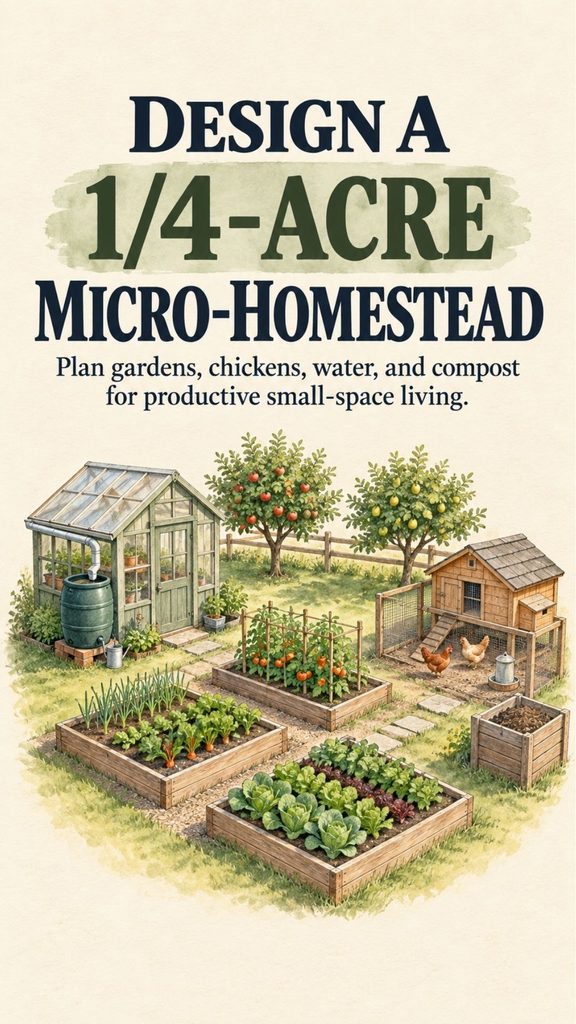
A quarter-acre lot may not look large enough for a serious homestead, but thoughtful design can turn it into a remarkably productive space. One-quarter acre equals about 10,890 square feet, although the house, driveway, patio, setbacks, and other structures may leave considerably less area available for food production.
That is still enough room for a substantial vegetable garden, herbs, berries, a few carefully selected fruit trees, composting, rainwater collection, and possibly a small flock of hens where local rules allow them.
The goal should not be to squeeze every possible homesteading activity onto the property. A productive small homestead works because each square foot has a purpose and the entire system remains manageable.
You Might Also Like:
- Loading posts...
Start with the land you actually have, design around sunlight and water, and build the homestead in stages.
Start With a Careful Site Assessment
Before building raised beds or ordering fruit trees, spend time observing the property.
A simple site survey can prevent years of frustration.
Pay attention to:
- Areas receiving the most direct sunlight
- Shade created by the house, trees, and fences
- Low spots where water collects
- Slopes and natural drainage
- Strong prevailing winds
- Existing trees and shrubs
- Outdoor faucets and downspouts
- Utility lines
- Property boundaries
- Access from the house
- Areas used by children or pets
Most fruiting vegetables perform best with plenty of direct sunlight. Tomatoes, peppers, squash, cucumbers, and beans generally deserve the brightest part of the property.
Leafy vegetables and some herbs can tolerate somewhat less light.
Observe the property at different times of day rather than assuming a sunny-looking corner receives enough light throughout the growing season.
Check Local Rules Before Designing Around Animals or Structures
Urban and suburban homesteading often comes with restrictions.
Before planning chickens, bees, sheds, greenhouses, fences, or large rainwater systems, check local regulations.
Rules may govern:
- Number of hens
- Whether roosters are permitted
- Coop setbacks
- Beekeeping
- Greenhouse placement
- Fence height
- Accessory structures
- Rainwater collection
- Composting
- Greywater use
Homeowners associations may have additional restrictions even when local law permits an activity.
It is much easier to adjust a paper plan than relocate a chicken coop after construction.
Draw the Property to Scale
A basic map is one of the most valuable planning tools for a small homestead.
Mark the house, driveway, existing trees, fences, paths, utilities, water sources, and permanent structures.
Then begin assigning space according to how often you will use each area.
Frequently visited areas should generally be close to the house.
That usually includes:
- Salad greens
- Culinary herbs
- Seedling areas
- Compost collection
- Frequently harvested vegetables
Fruit trees and other lower-maintenance perennial plantings can usually be farther away.
Example 1/4-Acre Micro-Homestead Layout
The exact arrangement will depend on the shape of your property, but a simple plan might look like this:
                NORTH
    ┌──────────────────────────────┐
    │   DWARF FRUIT TREES          │
    │   O      O      O            │
    │                              │
    │  BERRIES / PERENNIALS        │
    │  ███████████████████         │
    │                              │
    │ ┌────┐ ┌────┐ ┌────┐        │
    │ │BED │ │BED │ │BED │        │
    │ └────┘ └────┘ └────┘        │
    │                              │
    │ ┌────┐ ┌────┐ ┌────┐        │
    │ │BED │ │BED │ │BED │        │
    │ └────┘ └────┘ └────┘        │
    │      VEGETABLE GARDEN        │
    │                              │
    │ TRELLIS       COMPOST        │
    │ ||||||        [1][2][3]      │
    │                              │
    │ CHICKEN AREA*   WATER TANK   │
    │ [COOP + RUN]       ○         │
    │                              │
    │ HERBS     GREENHOUSE         │
    │ ▒▒▒▒▒     ┌──────────┐       │
    │            │          │       │
    │            └──────────┘       │
    │                              │
    │──────── HOUSE / PATIO ───────│
    └──────────────────────────────┘
                SOUTH

    *Only where local regulations permit.
This is only a planning model. Sunlight should determine the final placement.
A tall greenhouse, fruit tree, or fence should not shade the vegetable beds during the hours when they need the strongest light.
Put the Most Productive Area Near the House
A vegetable garden used almost every day should not be hidden in the farthest corner of the property.
Convenience matters.
When lettuce, herbs, tomatoes, and peppers are only a few steps from the kitchen, you are more likely to:
- Harvest regularly
- Notice pests early
- Water when necessary
- Pull small weeds
- Use the food before it becomes overripe
A smaller garden that receives consistent attention can outperform a much larger neglected one.
For a beginner, start with a few beds and expand only after maintaining them successfully for a season.
Build Healthy Soil Before Chasing Bigger Harvests
Soil quality has an enormous effect on garden productivity.
Before making major amendments, consider having the soil tested through a reliable local service. A soil test can reveal pH and nutrient conditions and prevent unnecessary additions.
Most vegetables prefer soil that is reasonably close to neutral, but different crops have different preferences.
Organic matter is one of the most useful improvements for many garden soils.
Well-finished compost can help:
- Improve soil structure
- Increase water-holding capacity in sandy soils
- Improve drainage in some heavy soils
- Support soil organisms
- Add nutrients gradually
Avoid assuming that one universal raised-bed recipe is ideal everywhere.
Locally available soil, climate, rainfall, and the materials already present all matter.
Consider No-Dig Beds
No-dig gardening can work particularly well on a small homestead.
Rather than repeatedly turning the soil, organic material is added to the surface and soil disturbance is kept relatively low.
For a new bed over lawn or weedy ground, one approach is:
- Mow or cut vegetation low.
- Lay plain cardboard with tape and plastic removed.
- Overlap the edges.
- Wet the cardboard.
- Add a generous layer of finished compost.
- Cover exposed surrounding soil with mulch if appropriate.
- Plant into the compost layer.
Cardboard eventually decomposes.
This method can reduce initial weed pressure, although persistent perennial weeds may still require follow-up removal.
Choose Crops by Productivity, Not Just Variety
On a small property, space deserves careful consideration.
That does not mean you should grow only the highest-yielding plants. Grow what your household actually eats.
Still, some crops provide a particularly good return for limited space.
Consider:
- Tomatoes
- Pole beans
- Cucumbers on trellises
- Peppers
- Lettuce
- Swiss chard
- Kale
- Radishes
- Green onions
- Garlic
- Herbs
- Zucchini where space permits
- Strawberries
Large sprawling crops such as pumpkins, melons, and winter squash can consume considerable ground space.
They can still be grown, but train suitable varieties vertically when practical or allow vines to spread along edges rather than through prime bed space.
Use Vertical Space Aggressively
Vertical gardening is one of the biggest advantages available to a micro-homestead.
Trellises can support:
- Pole beans
- Peas
- Cucumbers
- Some squash varieties
- Indeterminate tomatoes
Fences can also support espaliered fruit trees, grapevines, or other suitable climbers.
The principle is simple:
Instead of allowing a plant to occupy ten square feet horizontally, determine whether part of its growth can be directed upward.
Make trellises sturdy enough for the mature weight of the crop, especially with cucumbers and squash.
Position tall structures where they will not shade shorter crops unnecessarily.
Practice Succession Planting
A productive garden does not have to be filled completely on one planting day.
Succession planting allows one bed to produce several crops during the growing season.
For example:
SPRING          SUMMER           FALL
-------         -------          -------
Radishes   →    Beans       →    Spinach
Lettuce    →    Cucumbers   →    Lettuce
Peas       →    Basil       →    Greens
Exact timing depends on climate.
The idea is to replace finished crops promptly rather than leaving productive soil empty for months.
You can also sow quick crops such as lettuce, radishes, and green onions in smaller batches rather than planting everything at once.
That creates a more continuous harvest.
Grow Perennial Food Along the Edges
Perennial plants can provide food without being replanted every year.
Good possibilities include:
- Strawberries
- Raspberries
- Blackberries
- Blueberries where soil conditions suit them
- Grapes
- Rhubarb in suitable climates
- Asparagus
- Perennial culinary herbs
Borders, fence lines, and awkward corners are often useful places for perennial crops.
Be careful with aggressive plants.
Mint, for example, can spread rapidly and is often easier to control when grown in a container.
Add Dwarf Fruit Trees Carefully
Standard fruit trees can quickly become too large for a quarter-acre property.
Dwarf and semi-dwarf trees are generally easier to incorporate into small landscapes.
Possible choices include apples, pears, peaches, plums, figs, citrus, or other fruit suited to your climate.
Before buying, check:
- Mature tree size
- Climate suitability
- Chill requirements
- Disease resistance
- Pollination needs
- Rootstock
- Soil drainage
Some fruit varieties require another compatible variety nearby for good pollination.
Others are self-fertile.
Do not buy six trees simply because six fit on the drawing. Think about their mature canopy, root space, maintenance, and how much fruit your household can realistically use.
Espalier Can Save Valuable Space
Espalier involves training a fruit tree along a wall, fence, or support so that the branches grow in a relatively flat pattern.
A simple form looks like this:
         trunk
           │
    ───────┼───────
           │
    ───────┼───────
           │
    ───────┼───────
           │
           │
This technique can make fruit growing possible in narrow areas, but it requires regular pruning and training.
It is best viewed as a space-saving technique rather than a maintenance-free one.
Consider Chickens Only After the Garden System Works
Chickens can be a useful part of a small homestead where they are legal and where the household is prepared for daily care.
Hens can provide:
- Eggs
- Manure for composting
- Insect hunting
- Scratching and cleanup in appropriate areas
But they also require:
- Secure housing
- Predator protection
- Feed
- Fresh water
- Cleaning
- Veterinary care when necessary
- Space appropriate to flock size
- Year-round attention
Egg production varies greatly with breed, age, season, nutrition, health, and daylight.
Do not design a flock around an exact egg number promised online.
Four healthy hens may provide plenty of eggs for one household at certain times of year and considerably fewer during molting or winter.
Keep Chickens Out of Active Garden Beds
Chickens and vegetable gardens can complement each other, but usually not at the same time.
A chicken can destroy young seedlings surprisingly quickly through scratching and pecking.
Better options include allowing supervised access:
- After a crop is finished
- In designated orchard areas
- In movable runs
- During garden cleanup
Their manure should generally be composted appropriately before being incorporated into food-growing areas rather than being treated as ready-to-use fertilizer straight from the coop.
Build a Practical Compost System
Composting allows kitchen and garden waste to become a soil amendment rather than garbage.
A simple three-bin system might function like this:
┌─────────┐ ┌─────────┐ ┌─────────┐
│  BIN 1  │ │  BIN 2  │ │  BIN 3  │
│  FRESH  │ │ WORKING │ │ FINISHED│
│MATERIAL │ │ COMPOST │ │ COMPOST │
└─────────┘ └─────────┘ └─────────┘
You do not need three bins to compost successfully, but multiple sections can make managing material easier.
Useful compost ingredients include appropriate amounts of:
Greens
- Vegetable scraps
- Fresh grass clippings
- Garden trimmings
Browns
- Dry leaves
- Shredded plain cardboard
- Straw
- Small woody material
Avoid creating a wet pile consisting almost entirely of kitchen scraps.
A balance of carbon-rich and nitrogen-rich material, moisture, and oxygen supports decomposition.
Capture Rainwater Where It Makes Sense
Roof runoff can be useful for garden irrigation where rainwater collection is legal.
Rain barrels connected to downspouts can hold water for later use.
A simple system looks like:
    ROOF
  /──────\
       │
   DOWNSPOUT
       │
       ▼
  ┌─────────┐
  │ RAIN    │
  │ BARREL  │
  └────┬────┘
       │
     HOSE
       │
       ▼
   GARDEN BED
Use screened inlets to reduce debris and mosquito access, and direct overflow safely away from foundations.
A small barrel will not necessarily supply an entire garden through a long dry spell, but stored rainwater can supplement other irrigation sources.
Use Drip Irrigation for Efficient Watering
Drip lines and soaker systems deliver water directly near plant roots.
That can reduce evaporation compared with indiscriminately spraying large areas.
Combine drip irrigation with mulch to help the soil retain moisture.
Watering needs depend on:
- Soil type
- Temperature
- Rainfall
- Plant size
- Crop
- Mulch depth
Avoid watering purely according to a fixed calendar.
Check soil moisture and plant condition.
Give Paths Enough Space
It is tempting to make paths extremely narrow so that every inch becomes planting space.
That often creates frustration later.
You need enough room to:
- Carry harvest baskets
- Move compost
- Use a wheelbarrow
- Kneel beside beds
- Reach plants without stepping on soil
Main paths should be comfortably usable.
Narrower secondary paths can fit between small beds, but avoid layouts that force you to walk through growing areas.
Permanent paths also reduce soil compaction inside beds.
Add a Greenhouse Only If You Will Use It
A greenhouse can extend the growing season, protect seedlings, and create warmer conditions for certain crops.
It can also become extremely hot during sunny weather.
A useful greenhouse needs:
- Ventilation
- Reliable watering
- Temperature monitoring
- Suitable orientation
- Access
- Strong construction
For many beginners, a small seed-starting area or cold frame may provide more value initially than a large greenhouse.
Add structures after you understand your garden rather than assuming they are required from the beginning.
Build the Homestead in Phases
Trying to create the entire homestead during the first year is one of the easiest ways to become overwhelmed.
A more manageable plan might look like this:
| Phase | Main Projects |
|---|---|
| Year 1 | Soil test, compost, 2–4 vegetable beds, herbs, irrigation |
| Year 2 | Additional beds, berries, trellises, rainwater collection |
| Year 3 | Dwarf fruit trees, greenhouse or cold frame |
| Later | Chickens or other permitted livestock if desired |
There is nothing wrong with moving faster if you already have experience and resources.
For a beginner, however, every new system creates maintenance.
Six garden beds, four trees, chickens, bees, compost, and a greenhouse are not merely projects to install. They all require ongoing care.
Avoid These Common Micro-Homestead Mistakes
Trying to Grow Everything
A small homestead benefits from editing.
Grow foods your household actually wants.
Planting Trees Before Planning the Garden
Trees become permanent sources of shade.
Place them carefully.
Underestimating Paths
Access is part of productivity.
Building Too Many Raised Beds Immediately
Raised beds require soil, water, maintenance, and money.
Start with a manageable number.
Ignoring Water Access
A garden 100 feet from the nearest faucet becomes much harder to maintain.
Planting Too Densely
Intensive gardening does not mean eliminating airflow.
Crowding can increase competition and disease problems.
Forgetting Storage
You need somewhere for tools, pots, soil amendments, hoses, harvest baskets, and seasonal equipment.
Assuming a Quarter Acre Means Full Self-Sufficiency
A highly productive quarter-acre garden can provide a meaningful amount of fresh food.
It does not automatically provide every calorie, grain, cooking oil, animal product, or household necessity a family uses.
That does not make the homestead unsuccessful.
Reducing dependence and producing useful food are worthwhile goals even without complete self-sufficiency.
Design for Your Daily Life
The best micro-homestead is not necessarily the one with the most crops or animals.
It is the one you can maintain consistently.
Put herbs near the kitchen.
Keep compost convenient enough that you actually use it.
Place the most demanding vegetables where you naturally walk every day.
Use trellises where space is limited.
Grow perennial food around the edges.
Capture water where practical.
Leave enough paths to work comfortably.
And expand only after the existing system is functioning well.
A quarter acre is small enough that planning mistakes become obvious, but it is also small enough that thoughtful design can make almost every useful area work hard.
Start with a map, sunlight, good soil, and a few productive beds.
Then let the homestead grow along with your experience.