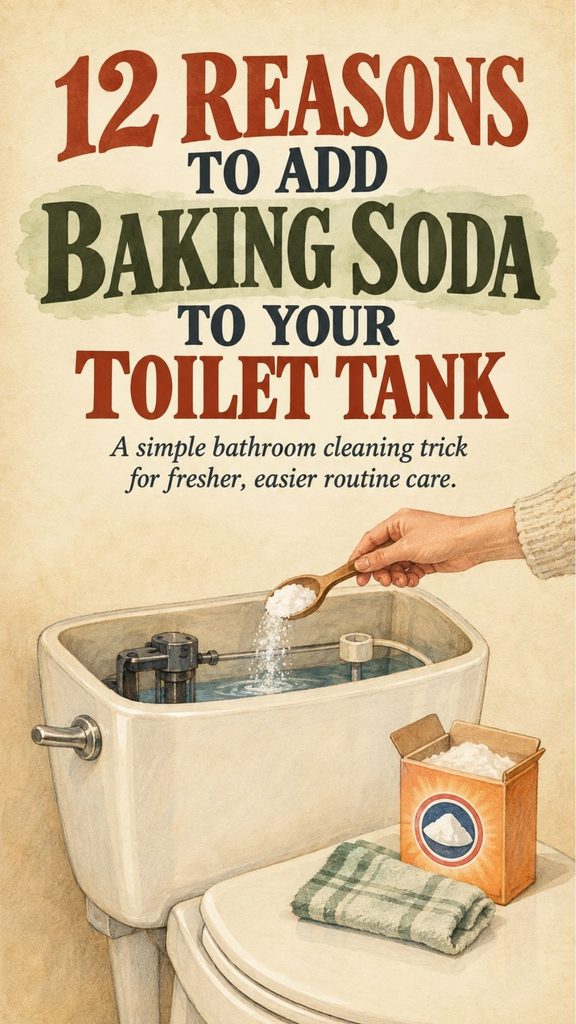
Baking soda is one of the most useful inexpensive cleaners in the home. It can absorb odors, provide gentle scrubbing action, and help clean many bathroom surfaces. That has led to a popular cleaning tip: pour baking soda directly into the toilet tank and leave it there to deodorize the toilet, fight hard-water buildup, improve flushing, and even extend the life of the toilet.
Some of those claims are exaggerated.
Baking soda can be useful when cleaning a toilet, but routinely adding it to the tank is not a miracle maintenance method. It will not repair a weak flush, remove serious mineral deposits, soften hard water throughout your plumbing, or replace proper toilet maintenance.
You Might Also Like:
- Loading posts...
Here are 12 things worth knowing before making baking soda part of your bathroom routine.
1. Baking Soda Can Help With Odors
Baking soda, or sodium bicarbonate, is commonly used to help neutralize certain odors.
That can make it useful when cleaning the toilet bowl and surrounding bathroom surfaces.
However, a toilet tank normally should not have a strong unpleasant smell. If odors continually return despite cleaning, the source may be somewhere else, such as the bowl, floor around the toilet, plumbing, drain, or another bathroom surface.
Adding more baking soda to the tank may temporarily mask part of the problem without addressing the actual cause.
For routine deodorizing, cleaning the bowl and surrounding surfaces is usually more useful than keeping baking soda permanently inside the tank.
2. It Is a Mild Cleaner, Not a Powerful Disinfectant
One reason baking soda is popular is that it is gentle compared with many aggressive cleaning chemicals.
When mixed with a small amount of water, it forms a mild abrasive paste that can help loosen grime.
That makes it useful for cleaning:
- Toilet bowls
- Exterior porcelain
- Sink surfaces
- Some bathroom tile
- Grout in appropriate situations
But baking soda should not automatically be described as a disinfectant.
If disinfection is necessary, use a product specifically labeled for that purpose and follow its directions carefully.
Cleaning and disinfecting are related, but they are not the same thing.
3. Baking Soda Will Not Fix a Weak Flush
One of the most misleading claims about adding baking soda to a toilet tank is that it “enhances flushing efficiency.”
If your toilet has suddenly developed a weak flush, baking soda is unlikely to solve the underlying problem.
Weak flushing can be related to issues such as:
- Incorrect tank water level
- A partially blocked toilet
- Mineral buildup in rim holes or jets
- A worn or incorrectly adjusted flapper
- Fill-valve problems
- Other mechanical or plumbing issues
A properly operating toilet depends on the correct amount and movement of water.
If flushing performance has changed noticeably, inspect the toilet rather than treating the tank with household powders.
4. It Does Not Truly Soften Hard Water
Hard water contains dissolved minerals, particularly calcium and magnesium.
Baking soda is sometimes promoted online as a way to “soften” the water inside the toilet tank and prevent mineral scale.
That description is misleading.
Adding a little sodium bicarbonate to a toilet tank is not equivalent to using a household water-softening system.
If your home has significant hard-water problems, you may notice chalky white deposits on faucets, showerheads, glass, sinks, and toilets.
A water-softening system, where appropriate, addresses minerals very differently. A spoonful or cup of baking soda in the toilet tank does not provide the same function.
5. It Is Not an Effective Limescale Remover
This is another common misunderstanding.
Baking soda is alkaline. Most stubborn bathroom limescale is made largely from mineral deposits such as calcium carbonate.
Acidic cleaners are generally much better suited to dissolving this type of deposit than alkaline baking soda.
Baking soda may help scrub away loose surface residue when used as a mild abrasive, but it should not be expected to dissolve substantial mineral scale inside a toilet.
If you have severe mineral buildup, first check the toilet manufacturer’s cleaning recommendations before applying stronger products.
6. The Toilet Bowl Is Usually a Better Place to Use It
If you want to use baking soda for ordinary toilet cleaning, the bowl generally makes more sense than the tank.
You can sprinkle a modest amount around the wet interior of the bowl, allow it to sit briefly, and scrub with a toilet brush.
Its mild abrasiveness can help with ordinary grime.
Flush afterward.
This allows you to use the ingredient where cleaning is actually needed without unnecessarily exposing tank components to repeated additives.
7. The Tank Can Be Cleaned Without Leaving Anything Inside It
Toilet tanks can collect sediment and mineral residue over time, particularly in areas with hard water.
If the tank genuinely needs cleaning, you can clean it directly rather than continuously adding cleaning ingredients.
A simple approach is:
- Turn off the toilet’s water supply.
- Flush to remove most of the water from the tank.
- Inspect the interior and components.
- Remove loose sediment carefully.
- Clean accessible surfaces with a mild cleaner suitable for the toilet.
- Avoid aggressively scrubbing rubber seals or delicate mechanisms.
- Turn the water back on.
- Allow the tank to refill and check that everything works normally.
Always follow the toilet manufacturer’s care instructions when available.
8. Be Careful With Anything You Put Inside the Tank
A toilet tank contains more than water.
Inside you may find rubber seals, a flapper or canister seal, a fill valve, flush valve components, plastic parts, metal hardware, and other mechanisms.
These parts are designed to stay in water, but that does not mean they are compatible with every cleaning chemical.
Some plumbing-component manufacturers specifically warn against certain drop-in tank cleaners containing bleach or chlorine because repeated exposure can damage tank parts and seals. :chatgpt-content-reference{index=”0″}
That does not mean baking soda causes the same damage. It does illustrate an important rule: the toilet tank is a mechanical system, not simply a cleaning bucket.
Use only products appropriate for the toilet and its components.
9. Baking Soda Is Not a Toilet Repair Product
If the toilet runs constantly, leaks into the bowl, refills slowly, makes unusual noises, or requires repeated flushing, adding a household cleaning ingredient is not maintenance.
Something probably needs adjustment, cleaning, or replacement.
For example, a deteriorated flapper can allow water to leak continuously from the tank into the bowl.
A malfunctioning fill valve can cause water-level problems.
A clog can restrict flushing.
Treat these as mechanical or plumbing problems rather than cleaning problems.
Fixing the cause can also prevent wasted water.
10. “Natural” Does Not Automatically Mean Necessary
Baking soda is appealing because it feels simple compared with strongly scented commercial cleaners.
That is perfectly reasonable.
You can use mild household cleaners where they are appropriate without assuming they need to be placed into every part of the plumbing system.
The U.S. Environmental Protection Agency, for example, notes that some homeowners with septic systems use mild detergent or baking soda for cleaning toilets, sinks, showers, and tubs. :chatgpt-content-reference{index=”1″}
That is different from regularly adding substances to a septic tank in an attempt to improve its operation.
Use baking soda as a cleaner when it helps. There is no need to turn it into a treatment for problems it cannot solve.
11. Baking Soda Is Not a Septic-System Booster
A particularly important myth is that regularly putting baking soda down the toilet improves septic-system performance.
A properly functioning septic system should not need routine household additives to make it work.
The EPA does not recommend septic-system additives as a general maintenance practice and notes that research has not demonstrated successful performance for baking-soda-type additives marketed to improve septic effluent. :chatgpt-content-reference{index=”2″}
If your home uses a septic system, proper maintenance matters much more.
That includes appropriate inspection and pumping, responsible water use, and avoiding materials that should not be flushed.
Do not try to solve a septic problem by pouring larger quantities of household ingredients into the toilet.
12. Simple Toilet Maintenance Works Better Than Viral Hacks
The best toilet-care routine is not particularly exciting, which may be why it rarely becomes a viral social-media post.
Keep the bowl clean.
Wipe the seat, lid, handle, exterior, and surrounding floor regularly.
Check for leaks.
Pay attention when flushing changes.
Deal with mineral buildup using a method appropriate for the toilet.
Keep tank components functioning correctly.
And avoid unnecessarily adding strong chemicals or random cleaning mixtures to the tank.
Those habits do much more for the toilet’s long-term condition than periodically pouring in a mystery combination of household ingredients.
What About Mixing Baking Soda and Vinegar?
Baking soda and vinegar create dramatic fizzing when combined.
That reaction can be useful for physically loosening some debris in certain household cleaning situations, but the fizz itself does not create a magical super-cleaner.
Baking soda is alkaline and vinegar is acidic. When mixed, they react with one another and largely neutralize each other’s acidity and alkalinity.
If vinegar is appropriate for a particular mineral deposit, using it according to the surface manufacturer’s recommendations may be more useful than immediately neutralizing it with baking soda.
Never assume that adding more ingredients makes a cleaning mixture more powerful.
Avoid Random Chemical Mixtures in the Toilet
Homemade cleaning recipes sometimes combine several products without considering how they react.
That can become dangerous.
Never casually combine household cleaning chemicals, particularly products containing bleach with acids, ammonia, or other cleaners.
If you have already placed one cleaner in the toilet, check its label before adding something else.
When in doubt, flush thoroughly and use one cleaning product at a time according to its directions.
A Better Baking Soda Bathroom Routine
Baking soda still deserves a place in the cleaning cupboard.
Use it where its properties are genuinely helpful.
It can provide gentle abrasive action for some suitable surfaces, help with ordinary grime, and assist with deodorizing.
For a toilet, that usually means using it during occasional bowl or surface cleaning rather than treating the tank as a permanent baking-soda reservoir.
The Bottom Line
Adding baking soda to your toilet tank is not the “must-do” trick that viral cleaning posts sometimes make it sound like.
It will not dramatically improve flushing.
It will not repair worn toilet parts.
It will not truly solve a household hard-water problem.
It will not replace proper limescale treatment.
And it is not necessary for keeping a septic system healthy.
Baking soda remains an inexpensive and useful mild household cleaner. The trick is using it for jobs it can actually perform.
For regular toilet care, focus on cleaning the bowl and exterior, inspecting the tank when necessary, keeping the internal mechanisms in good condition, and addressing plumbing problems at their source.
Sometimes the smartest cleaning hack is knowing when you do not need a hack at all.