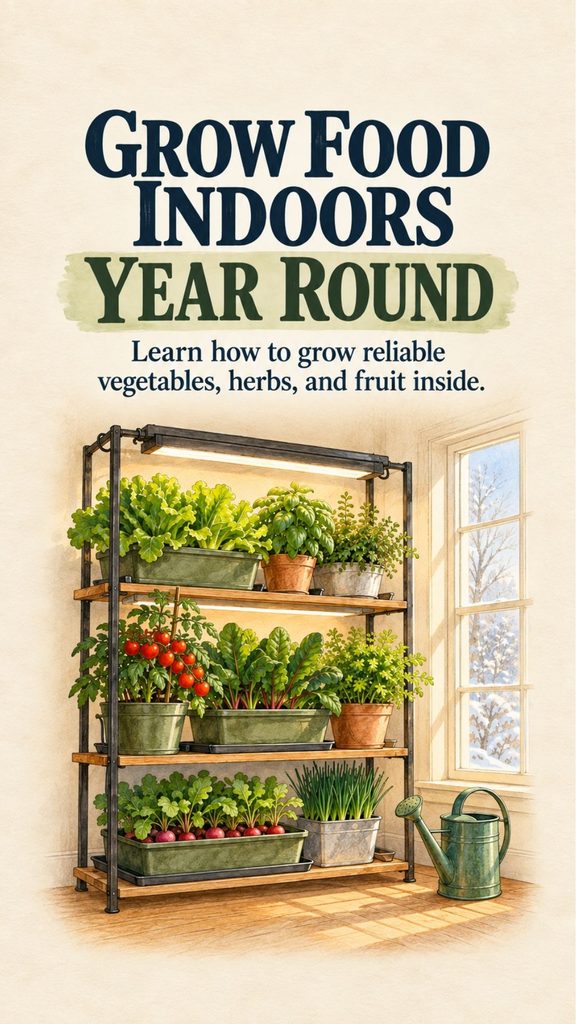
Growing food indoors can turn a bright window, spare corner, basement shelf, or enclosed porch into productive growing space throughout the year. It is especially useful for apartment dwellers, people with limited outdoor space, and gardeners who want fresh herbs and vegetables after frost ends the outdoor season.
An indoor garden does have limits. A few containers are unlikely to replace everything a household buys at the grocery store, and fruiting crops such as tomatoes and cucumbers require much more light and space than a pot of parsley or lettuce. Still, with realistic crop choices and good management, indoor gardening can provide a steady supply of herbs, greens, root vegetables, and even some fruits.
The key is to solve the challenges that outdoor gardens normally handle for you: strong light, drainage, airflow, pollination, soil fertility, and enough room for roots and foliage.
You Might Also Like:
- Loading posts...
Start With the Light You Actually Have
Light is usually the biggest limitation indoors.
A bright south-facing window in the Northern Hemisphere generally provides the strongest natural light, while east- and west-facing windows can also be useful. A darker window may support some leafy plants, but even crops considered tolerant of lower light still need adequate illumination to grow well.
Fruiting vegetables are considerably more demanding. Tomatoes, peppers, cucumbers, beans, and similar crops usually need strong light for many hours each day. The source recommends roughly 12 hours of light for many indoor crops and up to 12–16 hours for some fruiting vegetables. Pasted text
If your windows cannot provide enough light, grow lights are the most practical solution.
Modern LED grow lights are efficient and can be placed over shelves, carts, tables, or individual plants. A timer is useful because it provides a consistent daily schedule without requiring you to remember to switch the lights on and off.
Do not leave grow lights running continuously. Plants need a dark period as well as light, and their exact requirements vary by species.
Choose Containers With Drainage
Almost any sturdy container can become part of an indoor garden if it is food-safe for the intended use and provides enough room for the crop.
The source even suggests inexpensive large containers and 5-gallon buckets as simple starting points. Pasted text
Whatever you use, drainage matters.
A container without drainage holes can trap water around the roots, which increases the likelihood of root problems. Place pots on saucers or waterproof trays so excess water does not damage floors, shelves, or furniture.
Container depth should match the crop. Shallow-rooted lettuce and many herbs need less soil than carrots, potatoes, tomatoes, or cucumbers.
For indoor gardening, slightly larger containers are often easier to manage because they dry out less quickly and provide more room for roots.
Use a Light, Fertile Growing Mix
Garden soil taken directly from outdoors is usually not the best choice for indoor containers. It can compact heavily, drain poorly, and bring unwanted organisms indoors.
A good container mix should hold moisture while still allowing air around the roots.
The source recommends combining moisture-retaining and aerating materials with organic matter and notes that commercial potting mixes are another straightforward option. Pasted text
A quality bagged potting or container mix is the easiest choice for most gardeners.
Over time, container plants also exhaust available nutrients. Regular feeding may therefore be necessary, particularly for productive crops such as tomatoes and peppers. Follow the directions for the fertilizer you choose rather than assuming that more fertilizer will produce faster growth. Excess fertilizer can injure roots and create weak or unbalanced growth.
Be Careful Not to Overwater
Indoor plants are often harmed by too much attention rather than too little.
Outdoors, soil is exposed to wind, sun, deeper drainage, and larger fluctuations in moisture. Indoors, a container may remain damp much longer.
The source specifically warns that overwatering is an important indoor-gardening problem and recommends checking the soil before adding more water. Pasted text
Instead of watering strictly according to the calendar, check the growing medium.
Insert a finger into the upper inch or two of soil. If it still feels noticeably moist, the plant may not need additional water yet. If it feels dry, water thoroughly enough to moisten the root zone and allow excess water to drain.
Different crops have different needs. Lettuce may appreciate fairly consistent moisture, while rosemary generally performs better when its growing medium is allowed to dry somewhat between waterings.
Learning to judge moisture plant by plant is much more reliable than watering everything in the house on the same day.
Manage Temperature and Humidity
One advantage of indoor gardening is that temperatures are more stable than outside, but conditions can still vary dramatically between rooms.
A sunny windowsill can become surprisingly warm during the day and cold at night. Basements may remain cool, while upper floors can become hot and dry when heating systems run through winter.
The source notes that indoor humidity may fall significantly during the heating season. Pasted text
Instead of trying to create one perfect environment for every crop, group plants according to similar needs.
Cool-growing greens such as lettuce and spinach generally do not need the same conditions as heat-loving peppers.
Monitor the plants themselves. Brown leaf edges, persistent wilting, fungal growth, and constantly wet soil can all indicate that the environment needs adjustment.
Do Not Forget Air Circulation
Plants grown outdoors are constantly exposed to moving air. Indoors, especially on crowded shelves, air can become stagnant.
Gentle air movement helps moisture evaporate from foliage and can make the growing environment less favorable for some plant diseases.
A small oscillating fan can be useful for a larger indoor garden. It does not need to blast the plants. Gentle movement is enough.
Opening windows occasionally can also increase air exchange when outdoor conditions are suitable.
The source recommends paying attention to indoor air circulation rather than treating a growing room as a completely closed environment. Pasted text
Use Vertical Space
Indoor gardening becomes far more productive when you stop thinking only about floor space.
Shelving units can hold trays of greens and herbs. Hanging containers can use overhead space. Trellises allow some crops to grow upward rather than spreading across the room.
The source recommends vertical growing for climbing crops and notes that window sills, corners, shelves, porches, and similar spaces can all be turned into growing areas. Pasted text
For example, compact cucumbers or climbing beans can be trained onto a support. Small tomato varieties can grow against a short trellis. Strawberries can be grown in containers positioned under strong light.
Just make sure shelves, hooks, and supports are strong enough to hold wet soil. A freshly watered container can be much heavier than an empty pot.
Grow Crops That Match Indoor Conditions
Some plants are much easier indoors than others.
For a beginner, it makes sense to start with crops that mature quickly or tolerate containers well. Good possibilities include:
- Lettuce, spinach, kale, Swiss chard, radishes, green onions, basil, chives, cilantro, parsley, thyme, sage, rosemary, compact peppers, dwarf tomatoes, and strawberries.
The source identifies many of these as suitable indoor crops and provides different light and container-depth requirements depending on the plant. Pasted text Pasted text
Leafy greens and herbs are usually the easiest place to begin because they can provide useful harvests without needing flowers to develop into fruits.
Fruiting crops require more patience.
Dwarf or compact varieties of tomatoes and peppers generally make more sense indoors than full-size garden varieties. Cucumbers and beans can also work, but they need vertical support and enough light.
Root vegetables are possible as long as the container is deep enough for the root to develop properly.
Practice Succession Planting
One of the smartest ways to keep an indoor garden productive is to avoid planting everything at once.
If you sow all your lettuce on the same day, you may end up with more than you can eat for a short period followed by no lettuce at all.
Instead, sow smaller batches at intervals.
As one crop approaches harvest, start another.
The source emphasizes succession planting for fast-growing crops such as radishes, green onions, beets, and beans. Pasted text
The same principle works especially well with lettuce, spinach, cilantro, and other crops that are harvested frequently.
This creates a more continuous supply rather than one large harvest.
Pollinate Fruiting Plants When Necessary
Growing indoors removes many of the insects and wind currents that normally help flowers become fruit.
Some crops need very little assistance, while others benefit from manual pollination.
For tomatoes, gently shaking the flowering plant can help move pollen within the flowers. Other crops may require transferring pollen from one flower to another using a small brush or cotton swab.
The source specifically points out that indoor gardeners sometimes need to replace the work normally performed by outdoor pollinators. Pasted text
If a healthy plant flowers repeatedly but never produces fruit, inadequate pollination is one of the first things to investigate.
Harvest Frequently
Do not wait for plants to become enormous before using them.
Regular harvesting encourages many herbs and leafy vegetables to continue producing.
Pick outer lettuce leaves while allowing the center to grow. Cut herbs frequently before they become overgrown. Harvest beans and cucumbers while they are at an appropriate eating size rather than leaving mature produce hanging indefinitely.
The source also recommends regular harvesting as part of keeping an indoor garden productive. Pasted text
Once an annual crop has reached the end of its productive life, remove it and use the space for something new.
Think Realistically About Hydroponics
Hydroponic systems can make indoor food production much more space-efficient.
Instead of growing plants in conventional soil, many systems support roots in water while dissolved nutrients provide the minerals plants need. They can range from a small countertop unit to large vertical installations.
The source notes that hydroponic systems are particularly useful when growers want to fit more plants into limited space. Pasted text
However, hydroponics is not automatically easier than container gardening.
Water chemistry, nutrient concentration, lighting, pumps, and equipment maintenance become part of the system. Beginners may find a few ordinary pots more forgiving.
Start with the method you are most likely to maintain consistently.
Prepare for a Power Outage
If your garden depends heavily on artificial lighting, a prolonged power outage becomes more than a household inconvenience.
Plants positioned near usable windows have an advantage because they can continue receiving at least some natural light.
The source suggests prioritizing window access and moving plants toward brighter locations when electrical lighting is unavailable. Pasted text
For a small home garden, that is often more practical than designing an elaborate backup power system solely for plants.
If you use hydroponics, remember that pumps and aeration systems may also depend on electricity, so outages require additional planning.
Start Small and Expand What Works
It is easy to imagine an entire room filled with tomatoes, potatoes, strawberries, and climbing beans. In practice, an indoor garden is much easier to learn when you begin with a handful of dependable crops.
Try one tray of lettuce, a few herb pots, green onions, radishes, and perhaps one compact tomato or pepper under strong light.
Watch how quickly the containers dry. Learn how warm the growing space becomes. Observe how close the lights need to be. See which crops your household actually eats.
Then expand.
A productive indoor garden is less about filling every available corner with plants and more about creating a system you can maintain. Give crops enough light, use containers with good drainage, avoid overwatering, provide fresh growing medium and nutrients, maintain airflow, pollinate when necessary, and replant regularly.
Once those basics become routine, indoor gardening can provide fresh food through winter and continue producing long after the outdoor garden has gone dormant.