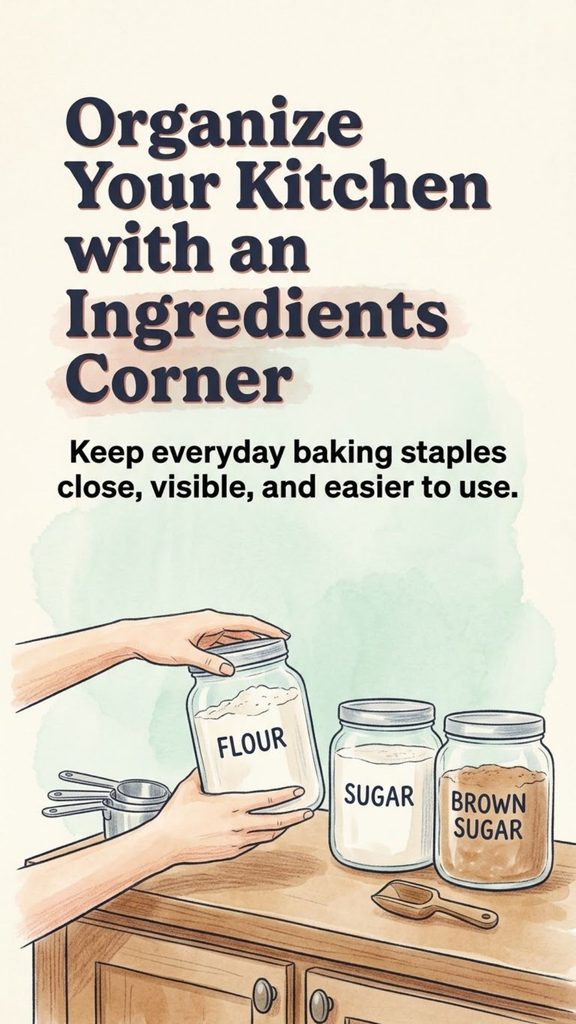
A well-organized kitchen should make cooking easier, not simply look attractive when everything is put away. Yet many kitchens are arranged according to habit rather than how food is actually prepared. Flour may be stored across the room from the counter where dough is mixed. Measuring spoons might live in one drawer while baking powder, vanilla, and sugar are scattered across several cabinets.
An ingredients corner solves that problem by grouping the foods and tools you reach for repeatedly in one practical work area.
Think of it as a small kitchen station built around the way you cook. If you bake often, it might become a baking corner stocked with flour, sugar, leavening agents, mixing bowls, and measuring tools. If you cook from scratch every day, it could include oils, salt, commonly used spices, grains, and other everyday staples.
You Might Also Like:
- Loading posts...
The point is not to create another picture-perfect pantry. It is to reduce unnecessary movement and make frequently used ingredients easier to reach, use, and put away.
Start With Where You Actually Work
Before buying containers or rearranging shelves, pay attention to where you spend most of your time preparing food.
For many people, the most valuable storage space is near the main preparation counter, sink, or stove. Ingredients used constantly during cooking are usually more useful there than appliances or serving dishes that are only needed occasionally.
Walk through the preparation of a meal or a batch of cookies in your mind.
Where do you measure ingredients?
Where do you mix?
Where do you knead dough?
Where do you set down bowls and utensils?
Where do you move when something needs to go into the oven or onto the stove?
That area should influence where your ingredients corner goes.
Traditional kitchen planning often uses the idea of a work triangle connecting the refrigerator, sink, and cooking area. You do not need to follow a rigid design rule, especially in a small or unusually shaped kitchen, but the basic principle is useful: frequently used supplies should require as little unnecessary walking as possible.
If a cabinet beside your main prep counter currently holds something you rarely use, consider whether that storage space could serve you better.
Give Prime Storage to Prime Ingredients
One of the most useful changes you can make is to stop treating pantry storage as automatically better than kitchen storage.
A large pantry may look beautiful, but if you walk across the room every time you need flour, sugar, salt, or baking soda, it may not be the most practical place for those ingredients.
Your most accessible cabinets and drawers should hold the things you reach for repeatedly.
That may mean moving an occasional-use appliance, specialty bakeware, holiday dishes, or bulk ingredients farther away so everyday staples can move closer to the work surface.
This can feel unusual at first. Many people automatically keep plates and glasses in their easiest cabinets because that is where those items have always lived. But dishes are often taken out once for a meal. Ingredients may be reached for several times during preparation.
Organizing according to frequency of use makes the kitchen work harder for you.
Decide How Much Space Your Ingredients Corner Needs
You do not need a large pantry or an entire wall of cabinetry.
A useful ingredients corner can fit into:
- One upper cabinet and the drawer beneath it
- A deep lower drawer
- Part of a pantry beside the main work area
- A countertop with a few containers and a nearby cabinet
- A rolling cart in a small kitchen
- A combination of drawers, cabinets, and countertop storage
Choose the arrangement that keeps your most-used supplies comfortable to reach.
Heavy ingredients such as large containers of flour are often easier to manage in lower cabinets or sturdy deep drawers. Lighter ingredients, spices, extracts, and smaller containers can work well above the counter.
Avoid putting frequently used items so high that you need a stool every time you cook. At the same time, do not fill the easiest shelves with specialty equipment that comes out twice a year.
Accessibility matters more than symmetry.
Stock the Corner With What You Really Use
The easiest mistake is turning the new area into storage for every possible baking or cooking ingredient.
Instead, begin with your everyday essentials.
For a baking-focused corner, that might include:
Everyday Baking Ingredients
- All-purpose flour
- Bread or whole-wheat flour if you use them regularly
- Granulated sugar
- Brown sugar
- Powdered sugar
- Baking powder
- Baking soda
- Salt
- Cocoa powder
- Cinnamon and other frequently used spices
- Vanilla or other commonly used extracts
- A neutral baking oil
You do not need every flour, sweetener, extract, or specialty ingredient in the same location.
If you own something you use only for one holiday recipe each year, give the closer space to an ingredient you use weekly.
This same rule applies outside baking. If you cook frequently, your corner might include rice, oats, pasta, lentils, cooking oils, salt, pepper, and the spices you reach for most often.
Let your habits determine the contents.
Keep the Right Tools Nearby Too
Ingredients are only half of an efficient work area.
If your flour and sugar are beside the counter but your measuring cups are across the kitchen, you have only solved part of the problem.
Keep the tools needed for those ingredients nearby whenever possible.
A baking station might include:
- Measuring cups
- Measuring spoons
- Liquid measuring cups
- Mixing bowls
- Silicone spatulas
- A whisk
- Dough scraper
- Rolling pin
- Pastry brush
- Hand mixer
- Frequently used baking pans
Again, frequency matters.
Cookie cutters you use once a year do not deserve the same prime storage as the whisk you use several times a week.
If space becomes tight, ask which item you would miss most during an ordinary week. Keep that one nearby and move the less-used item elsewhere.
Make Containers Work for You
Decanting ingredients into containers can be useful, but it is not a requirement for an organized kitchen.
Clear containers make it easy to see what is running low, and wide openings can make scooping flour or sugar more convenient. Airtight containers can also help protect dry ingredients from moisture and pests when properly closed.
But transferring everything into matching jars simply for appearance can create unnecessary work.
If the original package is easy to use, stores well, and clearly identifies the product, there is nothing wrong with keeping it.
For ingredients you do decant, labels are valuable even when the container is transparent. White flour varieties can look nearly identical. Baking soda and baking powder can easily be confused. A simple label prevents mistakes.
Consider adding the expiration or best-before date if removing the original packaging means losing that information.
Use Drawers and Cabinets More Efficiently
Once you know what belongs in your ingredients corner, make the space easier to use.
A few simple organizers can help.
Turntables
A small rotating organizer works well for extracts, baking decorations, small bottles, oils, and spices. Instead of reaching behind several containers, you can rotate the tray and bring what you need forward.
Drawer Dividers
Dividers keep measuring spoons, spatulas, small whisks, and other tools from becoming a tangled pile.
The goal is not to create tiny compartments for everything. Use enough separation to make tools easy to see and return.
Shelf Risers
If cabinet shelves have a lot of unused vertical space, a simple riser can create another level for smaller containers.
Under-Shelf Storage
Some cabinets can accommodate baskets that attach beneath a shelf. These can be useful for lightweight packets, decorating supplies, or small accessories.
Just make sure the added storage does not make the cabinet awkward to use.
Do Not Let Organization Create More Work
Kitchen organizers are supposed to remove friction. Sometimes they do the opposite.
A complicated storage system may look impressive but become irritating within a week. Measuring cups hanging decoratively on the wall are only helpful if you enjoy reaching for them there. Flour jars are only convenient if their openings are large enough to scoop from. Stacking containers are only efficient if you do not have to remove four of them to reach the one at the bottom.
Before committing to any system, imagine using it during a busy cooking session.
Can you grab the ingredient with one hand?
Can you see what is inside?
Can you put it away easily?
Does anything have to be moved first?
If a storage solution adds steps, it may not be much of a solution.
Make the Corner Pleasant Without Sacrificing Function
Practical storage does not have to look dull.
A baking or ingredients corner can still feel warm and personal. A recipe box, linen towel, wooden scoop, pretty storage jar, or small framed print can add character.
The important thing is to decorate around the work rather than decorating over it.
Do not crowd the countertop with objects that have to be moved every time you mix dough. Do not fill a useful shelf with decor while everyday ingredients are squeezed into an awkward cabinet.
Functional spaces often become beautiful because they reflect how the household actually lives.
A stand mixer used several times a week can stay on the counter and become part of the room. A collection of handwritten recipes can sit nearby. A favorite bowl may be both practical and attractive.
The best kitchens usually look lived in.
Keep Recipes Close to the Work Area
If you regularly cook from handwritten cards, printed recipes, or a binder, store them near your ingredients corner.
A small recipe box or binder can save repeated trips across the kitchen. A tablet stand can serve the same purpose if you use digital recipes.
Just keep paper and electronics away from direct heat, splashes, and wet work areas.
Frequently used recipes deserve the same treatment as frequently used ingredients: keep them where they are useful.
Organize for Your Style of Cooking
Not every ingredients corner should look the same.
A bread baker may want flour, yeast, salt, a kitchen scale, dough scraper, and proofing basket close together.
Someone who regularly makes cookies may prioritize sugars, chocolate chips, vanilla, baking sheets, cooling racks, and scoops.
A family that cooks savory meals from scratch may find that olive oil, vinegar, salt, garlic, onions, rice, and everyday spices make more sense than a dedicated baking setup.
You can even create smaller zones within the same kitchen:
- A baking cabinet
- A breakfast drawer
- A coffee station
- A lunch-making shelf
- A frequently used spice area
Organize around your real routines instead of someone else’s idea of what belongs together.
Review the Space After You Use It
The first arrangement does not have to be permanent.
Use your ingredients corner for a few weeks and pay attention to anything that annoys you.
Perhaps the flour is too high.
Maybe your measuring cups belong in the drawer instead of hanging nearby.
Perhaps you rarely use one ingredient taking up valuable space.
Maybe an item stored elsewhere keeps making you walk across the room.
Adjust the setup.
Good kitchen organization is not about finding one perfect arrangement. It is about continually reducing unnecessary effort.
A Better Kitchen Is One That Is Easier to Use
The most useful kitchen organization often looks surprisingly ordinary.
It may not involve rows of identical containers or a huge walk-in pantry. It may simply mean moving flour three feet closer to the mixing bowl, putting measuring spoons beside the ingredients they measure, or giving a hardworking cabinet a better purpose.
An ingredients corner works because it organizes the kitchen around actions rather than appearances.
Keep the supplies you use most where you use them. Move rarely used items out of valuable storage. Choose containers and organizers that genuinely simplify the work. Add beauty where it does not interfere with function.
The result is not just a tidier cabinet. It is a kitchen where cooking and baking require fewer unnecessary steps—and where putting everything away feels easier too.