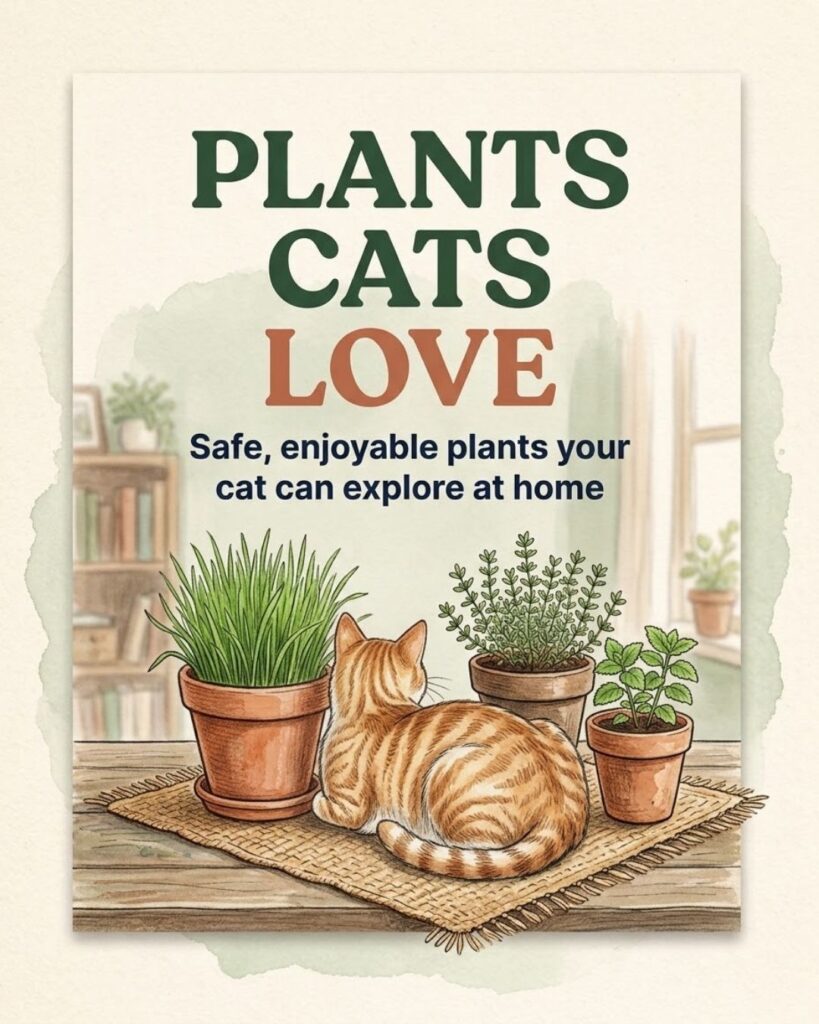
Cats have a habit of investigating plants with their noses, paws, and sometimes their teeth. For an indoor cat, a pot of fresh grass can become an interesting place to sniff, nibble, or simply sit beside. But choosing a “cat-friendly” plant requires more care than picking an herb that smells appealing.
Several plants commonly recommended online for cats are not as harmless as those lists suggest. Garden mint and lemongrass, for example, are classified by the ASPCA as toxic to cats and can cause gastrointestinal upset when enough is eaten. Concentrated essential oils are an even greater concern because cats can have difficulty processing some of their chemical components.
Fortunately, there are much better options. Cat grass, certain culinary herbs, and carefully managed catnip can provide cats with safe opportunities to interact with plants while helping protect your other houseplants from curious teeth.
You Might Also Like:
- Loading posts...
1. Cat Grass Is One of the Best Choices
If you want to grow one plant specifically for your cat, cat grass is one of the most practical choices.
“Cat grass” is not a single botanical species. The term usually refers to young cereal grasses grown indoors for cats, commonly including oats, wheat, barley, or rye. These tender shoots are easy to grow in shallow containers and give cats a designated patch of greenery to investigate.
Cornell University’s Feline Health Center specifically recommends oat grass as an alternative for cats that like chewing houseplants.
Some veterinary guidance also suggests that grass-eating cats may experience more regular gastrointestinal activity and fewer problems with constipation or hairballs, although grass should not be treated as a medical remedy.
Cats naturally swallow hair while grooming. Occasional hairballs can occur, but frequent vomiting should not simply be blamed on hair or treated by supplying more grass. VCA advises contacting a veterinarian if a cat is vomiting hairballs more than about once a month.
How to Grow Cat Grass
Growing cat grass indoors is straightforward:
- Fill a wide, stable container with potting mix.
- Sow untreated oat, wheat, barley, or rye seed.
- Cover the seeds lightly with soil.
- Keep the soil moist but not waterlogged while the seeds germinate.
- Place the container in a bright location.
- Allow the grass to become established before giving your cat unrestricted access.
A heavy pot is useful because an enthusiastic cat can easily knock over a lightweight container.
Avoid lawn grass that may have been treated with herbicides, pesticides, fertilizers, or other chemicals. Growing a dedicated pot indoors gives you much better control over what your cat is chewing.
2. Catnip Can Be Fun, but More Is Not Better
Catnip, Nepeta cataria, is probably the most famous plant associated with cats.
Its characteristic compound, nepetalactone, can produce striking behavioral responses in susceptible cats. Some become excited and playful, while others become relaxed or sleepy.
Not every cat responds to catnip, and the response is influenced in part by genetics.
Catnip also deserves a little more caution than the word “safe” sometimes implies. The ASPCA lists catnip as toxic to cats because consuming enough can cause vomiting and diarrhea; behavioral effects may include either stimulation or sedation.
At the same time, Cornell includes catnip and catmint among plant alternatives that can be offered to cats inclined to chew houseplants.
Those two pieces of guidance are not necessarily contradictory. A plant can be commonly used around cats while still causing problems when consumed excessively.
For that reason, catnip is better treated as an occasional enrichment plant than as something a cat should be encouraged to eat in large quantities.
You can grow it in a pot and allow your cat supervised access. If your cat starts consuming large amounts rather than simply sniffing, rubbing, or nibbling it, remove the plant.
3. Ordinary Culinary Thyme Is Considered Non-Toxic
Common culinary thyme, Thymus vulgaris, is another option for a cat-aware herb garden.
The ASPCA classifies common thyme as non-toxic to cats, dogs, and horses.
That makes it a more defensible choice than some herbs that appear on informal “plants cats love” lists.
However, common thyme should not be confused with every plant containing the word “thyme” in its common name.
This is an important example of why botanical names matter.
Spanish thyme, also called Indian borage and by several other names, is a different plant. The ASPCA lists Spanish thyme as toxic to cats and reports possible symptoms including vomiting, diarrhea, reduced appetite, and depression.
So if you are buying something labeled simply “thyme,” check the scientific name instead of relying only on the common name.
For a cat-accessible herb garden, Thymus vulgaris is the species with clear ASPCA non-toxic status.
4. Cat Thyme Is Not the Same as Culinary Thyme
“Cat thyme” is sometimes recommended as an alternative for cats that show little interest in catnip. Despite the name, it is not the same plant as ordinary culinary thyme.
This creates a problem for pet owners because common plant names are inconsistent. A label containing “thyme” does not tell you enough to determine whether the plant is appropriate for a cat.
Rather than assuming any plant sold as cat thyme is harmless, identify its botanical species and check it against a reliable veterinary toxicology source before allowing your cat to chew it.
The ASPCA itself warns that plant-toxicity lists are not exhaustive and recommends identifying the actual plant when determining risk.
If you cannot confidently identify a plant, keeping it out of reach is the safer choice.
5. Skip Lemongrass as a Cat-Nibbling Plant
Lemongrass often appears on lists of plants supposedly suitable for cats because its long leaves resemble grass.
That resemblance does not make it equivalent to cat grass.
The ASPCA classifies lemongrass as toxic to cats and notes that ingestion can cause stomach upset.
This does not mean that brushing against a lemongrass plant automatically causes poisoning. Toxicity depends on the substance, quantity, route of exposure, and other factors. But there is little reason to deliberately provide lemongrass for chewing when cereal grasses are available as better-established alternatives.
Lemongrass essential oil should be treated even more cautiously. Pet Poison Helpline warns that essential oils—including lemongrass oil—can produce serious adverse reactions in pets.
For a cat grass pot, stick with cereal grasses rather than aromatic grasses or essential-oil-producing plants.
6. Mint Is Another Plant Better Kept Out of the Cat Garden
Cats may investigate strong-smelling herbs, but interest does not prove that a plant is safe to eat.
Garden mint, Mentha species, is classified by the ASPCA as toxic to cats because of its essential oils. Large ingestions can cause vomiting and diarrhea.
That makes ordinary mint a poor choice for a container specifically intended for a cat to chew.
Confusion sometimes arises because catnip belongs to the mint family, Lamiaceae. But plants belonging to the same botanical family do not automatically have the same safety profile.
Catnip, common thyme, mint, and many other aromatic herbs are related, yet their chemical compositions differ.
Plant safety needs to be evaluated species by species.
7. Be Cautious With Licorice Root
Licorice root is another herb sometimes promoted online as a plant that cats should eat for general wellness.
That recommendation goes further than the evidence supports.
Licorice-derived ingredients do appear in some veterinary supplements. For example, VCA describes a veterinary supplement containing licorice root extract as one component of a formulation intended to support liver function.
That is very different from encouraging a cat to chew freely on a licorice plant or giving homemade licorice preparations.
Dose, extraction method, other ingredients, the cat’s health, and potential medication interactions all matter when an herbal substance is used therapeutically.
For a simple indoor cat garden, there is no need to include licorice root. If licorice is being considered for a health purpose, that is better discussed with a veterinarian rather than treated as an everyday snack.
Create a Simple Cat Garden Instead
You do not need a large collection of unusual herbs to give a cat some safe greenery.
A simple setup can be much easier to manage.
Try growing a sturdy container of oat or another suitable cereal grass as the main chewing plant. Cornell specifically identifies oat grass as an option for cats interested in vegetation.
If your cat enjoys catnip, grow it separately so you can control access.
Common thyme can also be included if you want a culinary herb with a clearly documented non-toxic status.
Keeping each species in its own labeled pot has another advantage: you always know exactly what your cat has been exposed to.
Plant Identification Matters More Than the Common Name
One of the biggest mistakes in pet-friendly gardening is buying plants according to common names alone.
Common names can refer to unrelated species.
The thyme example shows the problem clearly:
- Common thyme (Thymus vulgaris) is classified as non-toxic to cats.
- Spanish thyme is a different plant and is classified as toxic.
Before bringing home a plant that your cat can reach, look for the scientific name on the label.
If the nursery tag provides only a vague common name, identify the species before placing it where your cat can chew it.
Remember That “Non-Toxic” Does Not Mean Unlimited Eating
Even a non-toxic plant can cause problems if a cat consumes a large amount of plant material.
Cats are obligate carnivores, so plants should never replace a nutritionally complete feline diet. A cat garden is better viewed as enrichment and an occasional source of greenery rather than a meaningful source of nutrition.
Watch how your cat interacts with the plants. Casual nibbling is very different from repeatedly devouring an entire pot.
Persistent plant eating, repeated vomiting, diarrhea, appetite changes, lethargy, or unusual behavior deserve attention rather than being dismissed as normal plant-related behavior.
Plant chewing can also create physical hazards. Cornell notes that indoor cats may chew plants during normal exploration, which is one reason providing appropriate alternatives and restricting access to unsafe houseplants is useful.
Keep Truly Dangerous Houseplants Completely Out of Reach
Creating a cat-friendly plant corner does not make toxic plants elsewhere in the home safe.
Some ornamental plants pose much more serious risks than a mild stomach upset. Lilies are especially dangerous to cats; Cornell warns that ingestion of even a small amount can lead to life-threatening kidney failure.
If you live with a cat, check every houseplant rather than assuming that the animal will instinctively avoid dangerous species.
Cats explore their environment differently. A plant that has been ignored for months may suddenly become interesting after it is moved, trimmed, or placed near a favorite window.
A Better Shortlist for a Cat-Friendly Indoor Garden
The original idea behind a cat garden is a good one: give cats plants that are more appropriate to investigate so they have less reason to bother everything else in the house.
The safest version of that idea is also the simplest.
Start with oat, wheat, barley, or another cereal grass sold for growing as cat grass. Consider catnip for supervised enrichment if your cat enjoys it, remembering that excessive consumption can cause gastrointestinal upset. Common culinary thyme can also be grown because Thymus vulgaris is classified as non-toxic by the ASPCA.
Leave mint and lemongrass out of a garden intended for nibbling, and do not treat licorice root as a general feline health supplement without veterinary guidance.
Most importantly, identify every plant by species rather than assuming that a familiar name or a “natural” label means it is harmless.
A small pot of carefully chosen grass may not sound as exciting as a collection of five supposedly beneficial herbs, but for a curious cat, it provides exactly what is needed: something green to investigate without adding unnecessary risks.