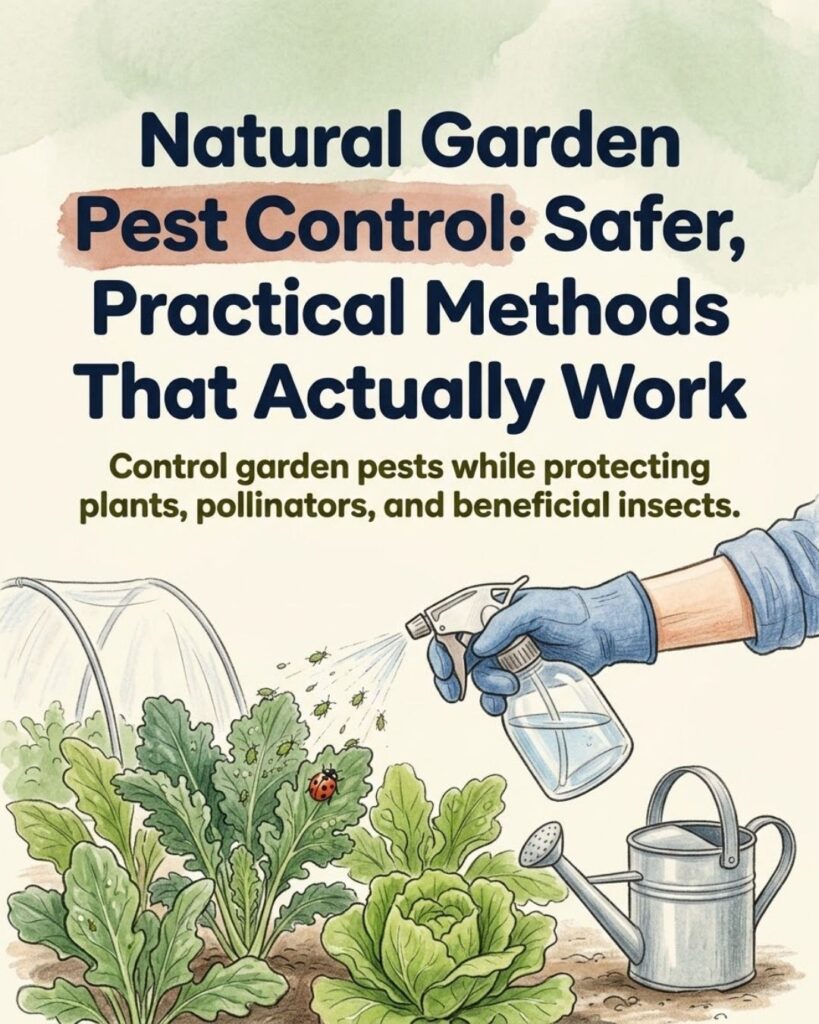
A few chewed leaves or a cluster of aphids does not mean the garden needs to be sprayed. In many cases, the most effective pest-control strategy starts long before any product comes out of the shed: grow healthy plants, identify what is causing the damage, protect natural predators, and interfere with pests only when their numbers are high enough to matter.
This approach is known as integrated pest management, or IPM. Rather than trying to eliminate every insect, IPM combines prevention, monitoring, physical barriers, biological controls and carefully chosen pesticides when they are genuinely needed. The U.S. Environmental Protection Agency recommends this type of approach because it can reduce unnecessary pesticide use while still controlling damaging pests.
That makes natural garden pest control less about finding a magical homemade spray and more about choosing the least disruptive solution that will solve the actual problem.
You Might Also Like:
- Loading posts...
Start by Finding Out What Is Really Eating Your Plants
Before treating anything, identify the pest.
This sounds obvious, but it prevents one of the most common gardening mistakes: spraying a plant because an insect happens to be sitting on it.
Gardens contain predators, pollinators, decomposers and harmless visitors along with true pests. Lady beetles, lacewings, parasitoid wasps, ground beetles and hover flies are among the beneficial insects that can help suppress pest populations.
Look at the entire plant before deciding what to do.
Check:
- the tops and undersides of leaves
- new shoots and flower buds
- stems near soil level
- the soil immediately around the plant
- the type of damage being caused
- whether insects, eggs, larvae or webbing are present
A few damaged leaves may require no treatment at all. IPM specifically encourages monitoring and deciding whether control is necessary before taking action.
Build a Garden That Is Harder for Pests to Exploit
Strong plants can still suffer from pests, so good gardening practices are not a guarantee of a pest-free garden. They can, however, reduce stress and make many pest and disease problems easier to manage.
Improve the Soil Without Overfeeding Plants
Compost and organic matter can improve soil structure and help soil hold appropriate amounts of water and nutrients. Match amendments and fertilizer to the needs of the plants rather than assuming that more fertilizer produces stronger growth.
Excess nitrogen can sometimes create large amounts of tender new foliage that is particularly susceptible to certain insects and diseases. For powdery mildew, for example, University of Minnesota Extension recommends avoiding excessive nitrogen because lush new growth is readily infected.
The practical goal is steady, balanced growth rather than forcing plants to grow as rapidly as possible.
Rotate Crops Where Rotation Can Help
If space permits, avoid repeatedly growing closely related vegetables in exactly the same location.
Crop rotation can be useful because some pests and pathogens survive near previous host plants. The EPA includes crop rotation among the cultural methods used in IPM to prevent pests from becoming established problems.
Rotation is not equally effective against every pest. Flying insects can simply arrive from elsewhere, and very small backyard gardens may not allow enough distance between old and new plantings to make much difference.
Still, rotating crop families is a worthwhile part of a broader prevention strategy.
Remove Seriously Diseased or Infested Material
A struggling plant should not automatically be pulled simply because it looks weak. First determine why it is struggling.
If a plant is badly diseased or heavily infested and unlikely to recover, removing it can prevent it from becoming a continuing source of trouble. Dispose of diseased material appropriately rather than automatically adding it to a home compost pile.
Also clean pruning tools when moving between plants where a transmissible plant disease is suspected.
Control Weeds and Unnecessary Debris
Weeds can compete with vegetables and may also provide alternate hosts or hiding places for certain pests. Remove problem weeds before they seed and keep the immediate growing area manageable.
That does not mean stripping the entire garden bare. Mulch, flowering borders and permanent habitat can be valuable for beneficial insects. The aim is intentional habitat rather than uncontrolled clutter.
Let Beneficial Insects Do Some of the Work
A completely insect-free garden would not be a healthy garden.
Many insects that gardeners notice are actually part of the pest-control system.
Lady beetles and their larvae consume aphids and other soft-bodied insects. Lacewings, hover-fly larvae and parasitoid wasps can also suppress aphid populations.
One of the best ways to encourage these predators is to provide a diverse collection of flowering plants over a long season. Herbs such as cilantro, dill and fennel can provide resources for several beneficial insects when allowed to flower, while other flowering plants can support predators and pollinators as well.
This is often more useful as a long-term strategy than repeatedly purchasing containers of beneficial insects. University of Minnesota Extension notes that diversifying garden plants can be a more effective long-term approach than simply ordering predators such as ladybugs.
Avoid unnecessary broad-spectrum insecticide treatments if you are trying to build this natural pest-control system. A treatment that kills the pest may also kill organisms that were helping control it.
The EPA advises treating only the areas that actually need treatment and minimizing pesticide use to reduce harm to beneficial insects and wildlife.
Use Physical Barriers Before Reaching for Sprays
Some of the most effective low-toxicity pest controls contain no active ingredient at all.
Floating Row Covers
Lightweight row covers can physically prevent certain flying pests from reaching crops and laying eggs.
They can be especially useful when installed before the pest arrives. The edges must be secured well because even small openings can allow insects underneath.
Timing matters.
For crops that require insect pollination, covers generally need to be removed once flowering begins unless another pollination arrangement is being used. University of Minnesota Extension recommends this approach for pests such as cucumber beetles and squash vine borers.
Row covers work best as prevention. Covering a plant after insects have already laid eggs underneath may simply trap the problem inside.
Handpicking
For large, slow-moving pests, hand removal can be surprisingly effective.
Caterpillars, beetles, slugs and egg masses are often easier to remove than to spray, particularly in a small vegetable garden.
Check plants regularly rather than waiting until severe damage appears.
A Strong Spray of Water for Aphids
Aphids often gather in dense colonies on tender stems and leaf undersides. On sturdy plants, a strong stream of water can knock many of them off.
This simple method is specifically recommended by University of California IPM guidance for aphid management. Natural predators can often deal with the insects that remain.
Repeat the treatment if necessary while watching for new colonies.
Plant Collars
Seedlings attacked at soil level may be suffering from cutworms. A physical collar around the base of a vulnerable transplant can make it more difficult for the larvae to reach the stem.
The important first step, however, is confirming that cutworms are actually responsible. Missing seedlings can also result from slugs, wildlife, transplant failure and other problems.
Deal With Slugs Without Spraying the Entire Garden
Slugs are not insects, but they are among the most frustrating garden pests, particularly in moist, sheltered areas.
Begin by reducing unnecessary hiding places immediately around vulnerable plants. Then inspect the garden in the evening or early morning.
University of Minnesota Extension recommends handpicking slugs and using boards, shingles or damp newspapers as temporary hiding traps. Slugs gather underneath, allowing them to be collected the following morning.
If the problem justifies a bait, iron phosphate products are considered a lower-toxicity option. Use only a product labeled for slug control and follow its directions rather than applying an improvised amount.
Use Insecticidal Soap Instead of Homemade Dish-Soap Sprays
Recipes combining dish detergent, cooking oil and water appear frequently in gardening advice. The fact that the ingredients are familiar household products does not make the mixture harmless to plants.
Commercial insecticidal soap is formulated from potassium salts of fatty acids and is designed for pest-control use. University of Minnesota Extension specifically warns against substituting homemade soap mixtures because they can burn plant tissue.
Insecticidal soaps can work well against exposed soft-bodied pests such as:
- aphids
- some scale insects
- spider mites
- whiteflies
- thrips
They generally work through direct contact and leave little residual activity, which means thorough coverage matters and repeat treatments may be necessary.
Spray the undersides of leaves where pests frequently hide, and always follow the product label.
Even lower-risk pesticides can injure sensitive plants if used incorrectly.
Consider Horticultural Oils for Selected Problems
Horticultural oils are another relatively targeted option for several garden pests.
They can help control mites, aphids and some scale insects by contacting and smothering vulnerable pest stages. University of Minnesota Extension lists horticultural oils and insecticidal soaps among lower-impact options for several pest problems.
Modern horticultural oils are formulated specifically for plant use. That is preferable to improvising a spray from kitchen oil and detergent.
Temperature, plant species, concentration and timing can affect the risk of plant injury, so label directions matter.
Avoid assuming that a treatment described as “natural” can be applied whenever or however you like.
Be Careful With Diatomaceous Earth
Diatomaceous earth is frequently advertised as an entirely harmless pest-control powder. Its real use requires more care.
Diatomaceous earth damages susceptible arthropods through physical abrasion and drying rather than poisoning them through a conventional chemical mechanism. Registered pesticide products containing it are available for a variety of pests.
But breathing the dust can irritate the respiratory tract, eyes and nose. The National Pesticide Information Center also warns that food-grade diatomaceous earth is not automatically an appropriate substitute for a pesticide-labeled product because food-grade products lack pest-control application instructions and precautions.
If you use diatomaceous earth for pest control, choose a product labeled for that purpose and use it exactly as directed.
Do not scatter large amounts indiscriminately around flowers where beneficial insects may encounter the dust.
Treat Spider Mites Differently From Ordinary Insects
Spider mites are tiny relatives of spiders, and severe infestations can cause stippling, discoloration and fine webbing on leaves.
Dry, hot conditions often favor damaging mite populations.
For manageable infestations, regular inspection and washing foliage can help. If treatment becomes necessary, insecticidal soap or horticultural oil can be effective options and generally have relatively little impact on people, animals and many non-target insects when used properly.
Coverage is critical because these products primarily affect mites they contact.
Do not assume that a stronger conventional insecticide will always solve a mite problem better. Pest identification should come before product selection.
Be Realistic About Milky Spore and Japanese Beetles
Milky spore is often promoted as a near-permanent cure for lawn grubs. That description is too broad.
Milky spore contains a bacterium that infects Japanese beetle grubs. It is not a universal treatment for every white grub species.
Penn State Extension notes that milky disease products may suppress Japanese beetle grubs but have little or no value against other scarab grubs.
That makes identification essential.
If lawn damage is being caused by another species, spreading milky spore may accomplish little.
Adult Japanese beetles can also fly into a garden from surrounding areas, so treating grubs in one lawn does not guarantee that adult beetles will disappear from flowers and vegetables.
For a small planting, handpicking adults can often be incorporated into regular garden inspection.
Use Sticky and Pheromone Traps Mainly as Information Tools
Sticky cards can help gardeners detect and monitor flying insects. Pheromone traps can be even more specific because they use chemical attractants associated with particular pest species.
But a trap catching insects does not necessarily mean it will eliminate the population.
For some pests, traps are most valuable because they tell you when the pest is active, allowing other controls to be timed more accurately. University of Minnesota Extension, for example, describes pheromone trapping as a way to monitor black cutworm moth activity and help predict potential damage.
Follow the instructions designed for the specific pest rather than assuming every pheromone trap should simply be hung at the edge of the garden.
Manage Powdery Mildew as a Plant Disease, Not an Insect Problem
White powdery growth on leaves is often mistaken for insect damage, but powdery mildew is caused by fungi.
The first response does not necessarily need to be a spray.
Spacing plants for better airflow, thinning dense growth, selecting resistant varieties and avoiding excessive nitrogen can reduce the severity of the disease. Mild infections may not justify treatment at all.
Contrary to a common assumption, powdery mildew fungi do not necessarily need wet leaves to infect plants. Some thrive under humid conditions even though the foliage itself remains dry.
If repeated disease makes treatment worthwhile, lower-impact fungicide options can include labeled products containing sulfur, potassium bicarbonate or horticultural oils. Fungicides are generally better at protecting healthy tissue than curing leaves that are already badly infected.
That is more predictable than relying on arbitrary homemade mixtures of baking soda, detergent, oil or milk.
Protect Seedlings From Larger Animals With Exclusion
Not every garden pest has six legs.
Deer, rabbits, voles and other mammals can cause far more damage in one night than an entire colony of aphids.
For persistent wildlife pressure, physical exclusion is usually more dependable than odor-based home remedies.
Fencing is particularly valuable for deer where damage is serious. Penn State Extension describes fencing as the most efficient way to reduce extensive deer damage in heavily affected areas.
Individual cages or barriers can be more practical around a few high-value plants.
For voles and similar rodents that damage trunks near ground level, hardware-cloth guards can protect young woody plants.
Repellents may provide additional protection, but their effectiveness varies and reapplication can be necessary. There is little reason to rely on claims that rodents are “allergic” to peppermint or that human hair will permanently solve a deer problem.
Remove obvious food sources, protect valuable plants physically and choose wildlife-control techniques appropriate to the actual animal involved.
Why “Natural” Does Not Automatically Mean Safe
Some of the most misleading garden advice comes from dividing pest controls into two categories: dangerous chemicals and harmless natural remedies.
Real pest management is not that simple.
Hot pepper can irritate skin and eyes. Soap can burn leaves. Oils can damage plants if applied under unsuitable conditions. Diatomaceous-earth dust can be irritating when inhaled. Botanical pesticides can affect organisms other than the intended pest.
Even water can damage plants if it is applied excessively.
The better question is not simply, “Is this natural?”
Ask:
What pest am I treating, does this method actually work against it, and what is the least disruptive effective option?
The EPA recommends preventive measures first and, when a pesticide is necessary, using it safely and according to its label.
A Simple Pest-Control Order to Follow
For most home gardens, a practical decision process looks like this:
- Identify the pest or disease correctly.
- Decide whether the damage is serious enough to require action.
- Correct plant stress, sanitation or growing-condition problems where possible.
- Use physical controls such as handpicking, water sprays, collars, traps or row covers.
- Protect and encourage natural enemies.
- If necessary, choose a targeted, lower-risk pesticide labeled for the pest and plant.
- Treat only the affected area and follow the label exactly.
- Check the garden afterward instead of automatically continuing treatments.
This is the central idea behind integrated pest management: use enough control to protect the garden without trying to sterilize the entire ecosystem.
A Healthier Garden Needs Some Insects
The goal of natural pest control should not be to kill everything that crawls across a leaf.
A productive garden contains pests, predators, pollinators and other organisms living alongside one another. A few aphids may feed a population of hover-fly larvae. Caterpillars may become pollinating moths or butterflies. Predatory insects need prey if they are going to remain in the garden.
What matters is keeping damaging populations below the point where they seriously interfere with the plants you are trying to grow.
Inspect regularly. Learn to recognize common pests and their natural enemies. Use barriers before infestations begin. Hand-remove problems that can easily be removed. Give beneficial insects habitat. And if a pesticide really is necessary, choose a product suited to the specific problem rather than spraying the entire garden.
That approach is not only gentler on beneficial wildlife. It is often simpler, cheaper and more sustainable than fighting every garden visitor with another homemade spray.