
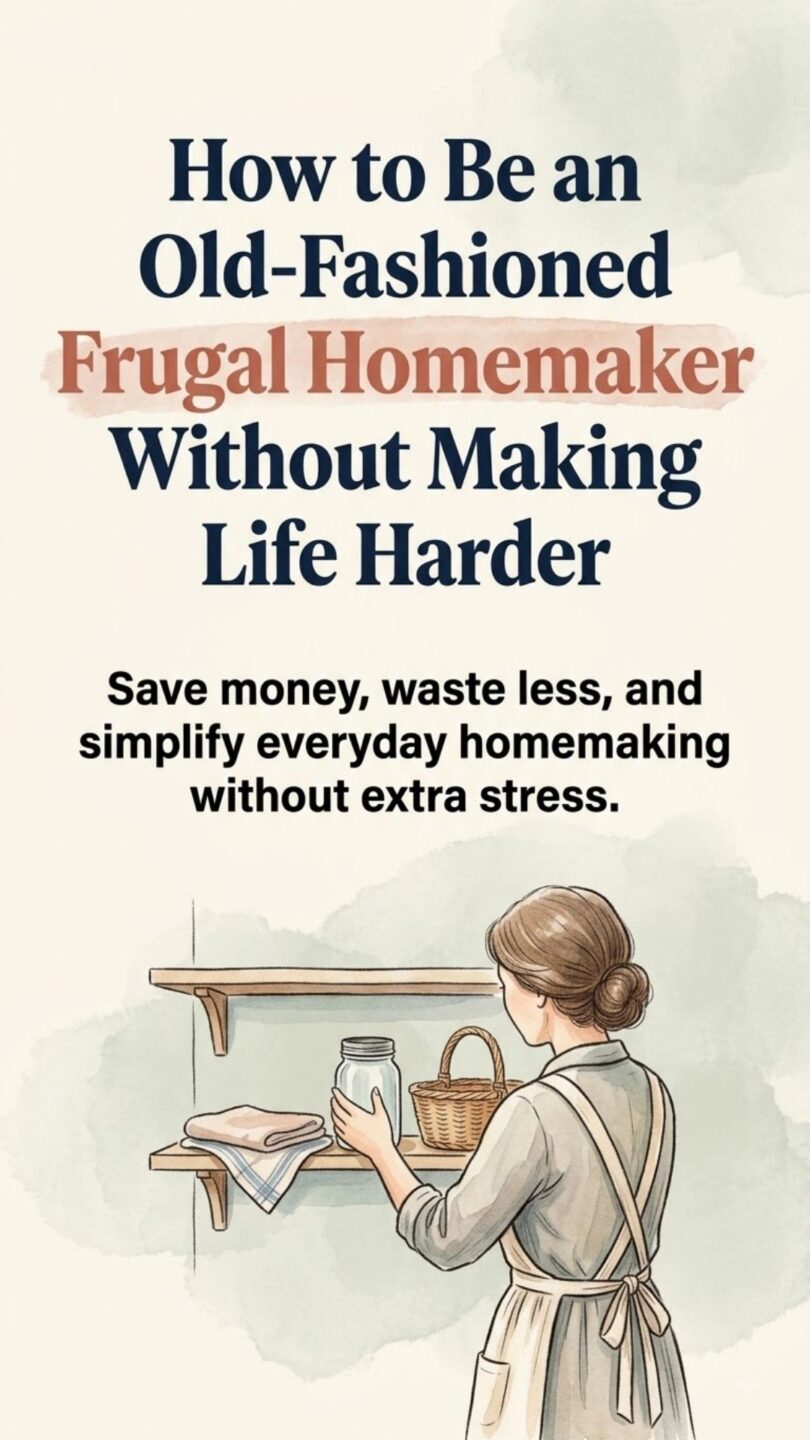
Old-fashioned frugality is less about denying yourself everything enjoyable and more about becoming careful with what enters, leaves, and gets wasted in your home. A frugal homemaker plans meals before food spoils, repairs useful things before replacing them, avoids unnecessary purchases, and learns practical skills that reduce dependence on expensive conveniences.
Many of these habits were ordinary household practices before disposable products, same-day delivery, and frequent replacement became common. They can still be useful today, but they work best when adapted to modern life rather than copied simply because they are traditional.
You do not need to grow all your own food, sew every piece of clothing, or make every household product from scratch. The goal is to spend intentionally, waste less, and make better use of the money, food, time, and possessions you already have.
You Might Also Like:
- Loading posts...
What Old-Fashioned Frugality Really Means
Frugality and cheapness are not the same thing.
Being cheap usually focuses on paying the lowest possible price, even when the cheaper option may perform poorly or need replacing quickly. Frugality looks at overall value.
A frugal homemaker might happily pay more for a sturdy kitchen pan that could last for years while refusing to spend regularly on single-use gadgets that solve problems she can already handle with what she owns.
The traditional frugal mindset is built around a few simple principles:
- Use what you already have before buying more.
- Take care of possessions so they last.
- Repair practical items when repair makes financial sense.
- Plan purchases rather than shopping impulsively.
- Reduce food and household waste.
- Learn useful skills that save money repeatedly.
- Buy quality where durability matters.
- Avoid spending simply because something is fashionable or convenient.
There is no need to turn frugality into a competition. A household that saves money by cooking at home may still choose to pay for a service that saves significant time or prevents injury. Good frugality considers money, time, effort, safety, and quality of life together.
Start With a Household Budget You Can Actually Follow
A budget is one of the least glamorous homemaking tools, but it influences almost everything else.
Before cutting expenses randomly, find out where your household money is going. Review regular costs such as housing, utilities, groceries, transportation, insurance, debt payments, subscriptions, household supplies, clothing, entertainment, and irregular expenses.
Then separate expenses into broad categories:
Essential expenses: housing, basic food, utilities, transportation, insurance, and necessary medical or family costs.
Financial priorities: emergency savings, debt repayment, retirement contributions, or savings for upcoming expenses.
Flexible spending: dining out, entertainment, decor, convenience purchases, subscriptions, hobbies, and optional shopping.
The purpose is not to eliminate every pleasure. It is to make sure optional spending is not quietly consuming money needed for more important goals.
A useful old-fashioned habit is delaying nonessential purchases. Instead of buying something immediately, write it down and reconsider it after several days. Often, the desire disappears.
This works especially well for decor, kitchen gadgets, clothing, storage containers, seasonal merchandise, and inexpensive online purchases that seem harmless individually but add up over time.
Build Meals Around What You Already Have
Food is one of the easiest areas for household waste to hide.
A frugal meal plan should begin in the kitchen, not at the grocery store.
Before planning the week, check:
- The refrigerator for ingredients that need to be used soon.
- The freezer for meat, vegetables, bread, and prepared meals.
- The pantry for grains, pasta, beans, canned foods, baking ingredients, and other staples.
- The weekly schedule to see which days require fast meals.
Then plan meals that use those ingredients first.
For example, if you have half a bag of carrots, cooked rice, eggs, and frozen vegetables, those ingredients can become part of fried rice, soup, a casserole, or several side dishes instead of being forgotten until they spoil.
A realistic meal plan also includes leftovers. Planning seven completely different dinners may create more work and waste than planning five meals and intentionally eating leftovers once or twice.
Shop With a List, but Compare Prices Carefully
A grocery list reduces random purchasing, but a list alone does not guarantee savings.
Pay attention to unit prices when comparing different package sizes. The largest package is not automatically the cheapest per ounce, pound, or item.
Bulk buying makes the most sense for foods your household consistently uses and can store safely. Buying a huge package of something that eventually goes stale is not frugal.
Seasonal produce can sometimes be less expensive when supplies are plentiful, although prices vary by region, store, weather, and local growing conditions. Frozen fruits and vegetables can also be economical because they keep much longer and can reduce spoilage.
Store brands are often worth considering, especially for basic ingredients. However, compare quality and ingredients rather than assuming either name brands or store brands are always better.
The most expensive grocery item is often the one you throw away.
Cook More From Basic Ingredients
Cooking at home is a traditional homemaking skill with strong financial potential.
You do not need to prepare elaborate meals from scratch every night. Focus on learning a dependable collection of inexpensive meals your household actually enjoys.
Useful staples might include:
- Soups and stews
- Rice dishes
- Pasta meals
- Bean-based dishes
- Egg meals
- Homemade breads or simple baked goods
- Roasted vegetables
- Casseroles
- Sandwiches and wraps
- Meals built around leftovers
Convenience foods are not automatically wasteful. Frozen vegetables, canned beans, jarred sauces, rotisserie chicken, or pre-cut ingredients may be worthwhile if they help you avoid restaurant meals or discarded food.
The frugal choice is the one that works consistently in your household, not necessarily the option that requires the most labor.
Learn a Few Basic Repair Skills
Previous generations often repaired ordinary household items because replacing them was expensive or inconvenient. That principle can still save money.
You can start with simple skills such as:
- Sewing on buttons
- Repairing loose hems
- Patching small tears
- Tightening cabinet hardware
- Touching up scratched furniture
- Reattaching loose handles
- Fixing simple household items when safe to do so
Not every item should be repaired. Electrical appliances, gas systems, structural repairs, and other potentially dangerous jobs may require qualified professionals.
There is also a point where repair becomes uneconomical. Spending almost as much to repair a low-quality appliance as it costs to replace it with a more reliable one may not make sense.
The principle is simply to ask, “Can this reasonably be fixed?” before automatically throwing it away.
Take Better Care of What You Own
Maintenance is one of the most overlooked forms of frugality.
Clothing lasts longer when washed according to its care instructions and stored properly. Shoes last longer when allowed to dry and cleaned regularly. Appliances may work more efficiently when filters, vents, and other serviceable parts are kept clean according to the manufacturer’s instructions.
Furniture, cookware, tools, and household equipment often deteriorate faster through neglect than ordinary use.
Create a simple maintenance routine rather than waiting until something breaks.
Small actions can include cleaning refrigerator coils where accessible and recommended, replacing HVAC filters at appropriate intervals, descaling suitable appliances, checking for plumbing leaks, cleaning dryer lint filters, and storing tools where they will remain dry.
Preventive maintenance will not make everything last forever, but it can reduce unnecessary deterioration.
Be Careful With Homemade Cleaning Products
Homemade cleaning solutions can be inexpensive, but they should be based on sound cleaning principles rather than internet recipes that mix ingredients simply because they are common household products.
For example, vinegar is acidic and baking soda is alkaline. Mixing them creates a visible fizz, but they largely neutralize each other. The bubbling can sometimes help loosen debris mechanically, but the mixture is not automatically a stronger general-purpose cleaner.
For many routine surfaces, warm water and a small amount of dish soap are enough.
Diluted vinegar may be useful for certain mineral deposits and suitable surfaces, but acidic cleaners can damage some natural stone and other materials. Baking soda can provide gentle abrasive action for appropriate surfaces.
Never mix bleach with ammonia, acids, vinegar, or other household cleaners. Dangerous gases can be produced.
Frugality should never come at the expense of safe product use.
Grow Food Only If It Makes Sense for You
Gardening can be a rewarding part of frugal homemaking, especially when you grow foods that are productive, expensive to buy regularly, or difficult to find fresh.
You do not need a large garden. Herbs, lettuce, peppers, tomatoes, or other suitable plants can sometimes be grown in containers where climate and space allow.
However, home gardening is not automatically cheaper than grocery shopping.
Soil, containers, fertilizer, irrigation, seeds, tools, and pest problems can increase the cost. A garden becomes more economical when equipment is reused for several seasons and crops are chosen carefully.
It is also inaccurate to assume homegrown food is automatically pesticide-free. That depends entirely on how the plants are grown and what products are used.
Treat gardening as a combination of food production, practical skill, and recreation rather than expecting every tomato to produce a financial profit.
Preserve Extra Food Instead of Letting It Spoil
If you garden, buy seasonal produce in quantity, or regularly have extra food, preservation can help reduce waste.
Freezing is one of the simplest methods. Many fruits, vegetables, breads, cooked meals, sauces, and baked goods freeze well when properly packaged.
Drying can also work for herbs and certain foods when done correctly.
Home canning requires more care. Safe canning methods depend on food acidity, processing method, jar preparation, and tested recipes. Low-acid foods generally require pressure canning rather than boiling-water canning.
Do not improvise canning times or recipes based solely on old family methods. Food preservation is one area where modern safety guidance is more valuable than nostalgia.
Buy Second-Hand With a Purpose
Thrift stores, estate sales, garage sales, consignment shops, and online marketplaces can offer good household items for much less than new retail prices.
Some of the best categories to consider second-hand include:
- Furniture
- Solid wood storage pieces
- Certain kitchen tools
- Books
- Baskets
- Decor
- Tools
- Children’s clothing that will be quickly outgrown
- Occasion-specific items
But a bargain is only a bargain if you need it.
Second-hand shopping becomes expensive clutter when low prices encourage unnecessary purchases. Decide what you are looking for before you browse.
Certain products are also better purchased new for hygiene, safety, or reliability reasons. Evaluate each category separately rather than treating all second-hand goods as equally suitable.
Use a “Make Do First” Rule
Before buying something for the house, ask whether another item can serve the same purpose.
A glass jar might store dry goods. A shoebox might organize small craft supplies. An old towel might become cleaning rags. A sturdy basket may work in several rooms before a new organizer is necessary.
This does not mean saving every container that enters your home.
Keeping dozens of objects “just in case” creates another problem: clutter.
Set limits. Keep only useful materials in quantities you can realistically store and use.
Frugality should simplify your home, not turn it into a warehouse.
Make Gifts and Decorations Selectively
Homemade gifts can be thoughtful and economical when you already have the skills and materials.
Baked goods, handmade cards, simple crafts, framed photographs, sewn items, or small homemade food gifts can be meaningful alternatives to expensive purchases.
But handmade does not automatically mean cheap. Craft supplies can cost more than a finished item, particularly if you purchase specialized equipment for one project.
Use what you already know how to make well.
The same principle applies to seasonal decorating. Instead of buying new decorations every year, reuse what you own, bring in natural seasonal elements where appropriate, and rotate existing decor.
Tradition often feels more personal when the same well-loved pieces return year after year.
Reduce Clutter Before Buying Storage
One of the most modern frugal mistakes is purchasing products to organize things that should have been removed.
Storage bins, drawer dividers, baskets, shelving units, and closet systems can be useful, but they cannot solve excessive accumulation.
Before buying organizers:
- Remove broken or unusable items.
- Donate or sell things you no longer need.
- Group similar items together.
- See what existing containers can be reused.
- Buy storage only for what remains.
This approach combines frugality with a practical form of simplicity. The goal is not to own the smallest possible number of possessions. It is to avoid paying to store unnecessary ones.
Protect Your Time as Carefully as Your Money
Traditional frugality sometimes involved a large amount of household labor. Modern homemakers have to decide which tasks are worth doing personally.
Making bread may save money in one household and create unnecessary stress in another. Repairing clothing may be worthwhile if you enjoy sewing but frustrating if you have little time and rarely need repairs.
Calculate more than the price of ingredients.
Consider the time involved, necessary equipment, learning curve, storage space, and how frequently you will repeat the task.
The best frugal habits are sustainable enough to become ordinary routines.
Create a Homemaking System You Can Maintain
Frugality becomes easier when it is built into daily household systems rather than treated as a temporary money-saving challenge.
You might choose a few weekly habits:
- Plan meals before grocery shopping.
- Use leftovers before cooking something new.
- Review upcoming expenses.
- Spend one day without unnecessary purchases.
- Repair one neglected item.
- Check the refrigerator for food that needs using.
- Declutter one small area.
- Prepare inexpensive meals for busy days.
Small routines performed consistently usually matter more than occasional extreme efforts.
A More Practical Kind of Old-Fashioned Homemaking
Being an old-fashioned frugal homemaker does not require recreating life from another generation. Some older habits remain useful; others have been improved by modern knowledge, technology, safety standards, and changing lifestyles.
Keep the principles that still work: planning ahead, wasting less, maintaining what you own, cooking practical meals, repairing when sensible, reusing thoughtfully, buying second-hand selectively, and distinguishing genuine needs from impulse purchases.
Then adapt them to your own household.
Frugality works best when it gives you greater control over your money and possessions without making everyday life unnecessarily difficult. A well-run frugal home is not one where nothing is ever purchased. It is one where purchases have a purpose, food is valued, useful things are cared for, waste is noticed, and household resources are handled thoughtfully.



Leave a Comment